

Influencer Marketing: Creator Tiers, Cost, Pricing Models, Metrics, Disclosure Rules, Platforms, Risks, Contract Terms, Workflow, Engagement Rates
Influencer marketing is a promotional practice in which brands pay or partner with social media creators to reach their audiences. Key aspects include cost, creator tiers, metrics, pricing models, platforms, disclosure rules, contract terms, risks, engagement rates, and workflow. It works through creators who publish sponsored posts, videos, or stories on social platforms where their followers already spend time. Within marketing, it sits between advertising and word-of-mouth, because audiences often treat a creator’s recommendation as more personal than a standard advertisement. Some brands coordinate campaigns in-house, while others rely on internet marketing agencies near me to handle sourcing, contracts, and reporting. You will find that this article explains cost, creator tiers from nano to mega, pricing models such as flat fees and commissions, the main platforms, and the metrics used to measure results.
Key Takeaways
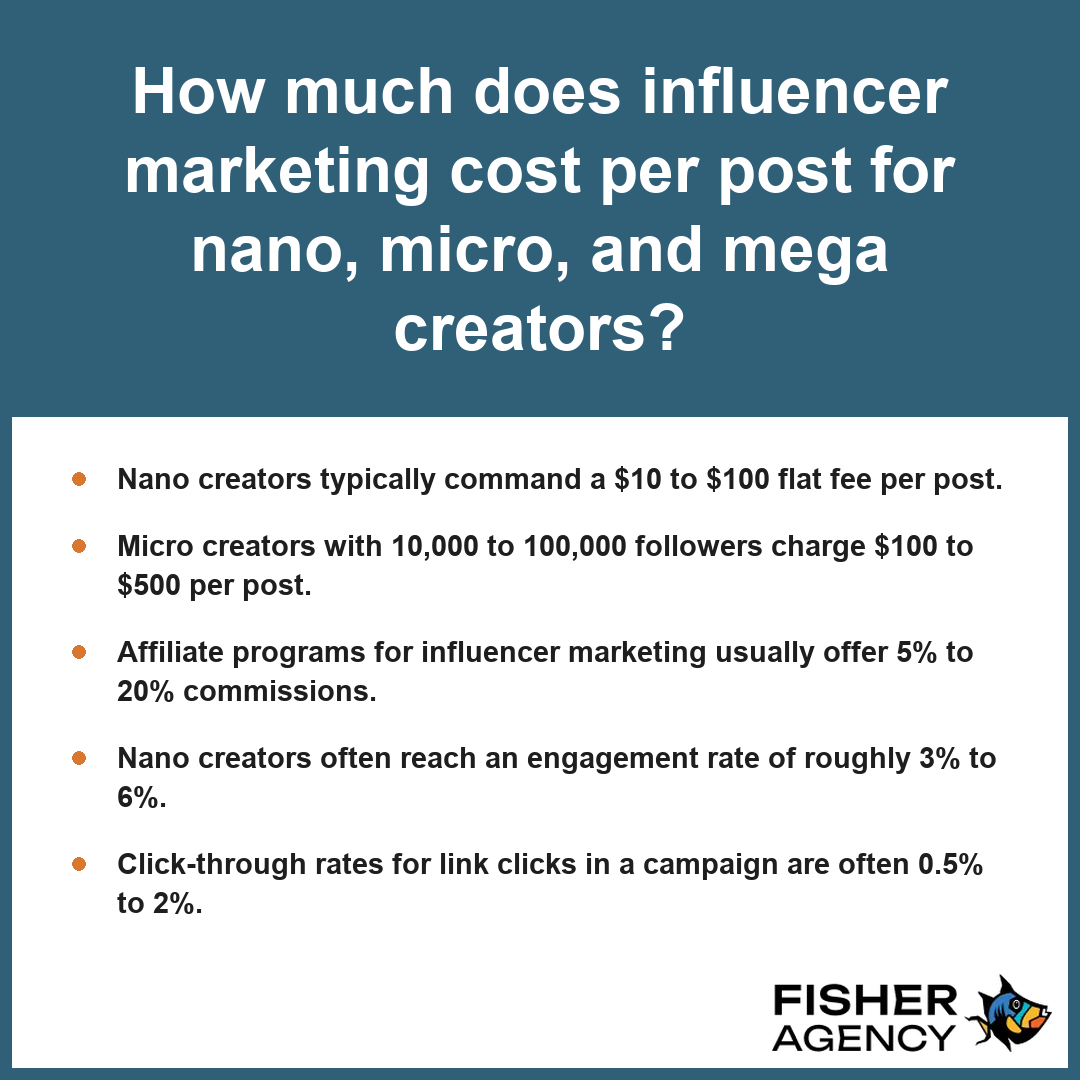
- Nano creators typically command a $10 to $100 flat fee per post.
- Micro creators with 10,000 to 100,000 followers charge $100 to $500 per post.
- Affiliate programs for influencer marketing usually offer 5% to 20% commissions.
- Nano creators often reach an engagement rate of roughly 3% to 6%.
- Click-through rates for link clicks in a campaign are often 0.5% to 2%.
Influencer Marketing Cost Per Post for Nano, Micro, and Mega Creators
Influencer marketing cost per post for nano, micro, and mega creators varies based on audience size, with expenditures typically scaling according to the reach and perceived value of the creator’s platform presence. Per Association of National Advertisers, marketing industry benchmarks consistently indicate that influencer compensation scales disproportionately, with costs per post rising significantly as creator reach transitions from micro-level to mega-level tiers.
Typical Cost Per Post by Creator Tier (Maximum End)
| Creator Tier | Follower Range | Typical Flat Fee Per Post |
|---|---|---|
| Nano creator | 1,000–10,000 | $10 to $100 |
| Micro creator | 10,000–100,000 | $100 to $500 |
| Mega creator | Over 1,000,000 | $10,000+ |
While these figures serve as a foundational guide for influencer marketing budgeting, actual rates often fluctuate based on content complexity, usage rights, and the specific platform requirements of your campaign. Many brands apply a general rule of thumb estimating $100 for every 10,000 followers, but this serves only as a starting point for negotiations rather than a fixed industry standard. Because mega creators command broader visibility, they often secure fees reaching into the six-figure range, whereas smaller tiers are frequently more cost-effective for niche targeting. Always compare the projected reach and engagement rate of a potential partner against these flat fee expectations to ensure your budget aligns with your specific conversion goals.
Evaluate your total budget against the projected engagement rate of each tier to ensure the cost per thousand impressions remains within your efficiency targets.
Beyond base follower counts, consider these key factors that influence final compensation negotiations:- Engagement Metrics: High comment and share rates often justify a premium above base flat fees.
- Usage Rights: Fees increase when brands request the right to repurpose content for paid advertisements or social media assets.
- Content Production Requirements: Complex editing, script development, and high-production value shoots necessitate higher creative fees.
- Exclusivity Clauses: Restricting a creator from working with your direct competitors usually adds a significant surcharge to the total contract.
- Platform Specifics: Video-heavy platforms like TikTok or YouTube often command different pricing structures than image-based platforms like Instagram.
What Is the Difference Between Nano, Micro, Macro, and Mega Creators in Influencer Marketing?
The difference between nano, micro, macro, and mega creators in influencer marketing is defined primarily by their total follower count, which dictates their reach, the nature of their community rapport, and the scale of their audience influence.
| Creator Tier | Follower Count | Engagement Expectation | Primary Campaign Goal | Budget & Management Intensity |
|---|---|---|---|---|
| Nano | 1,000 – 10,000 | High (3% – 6%) | Trust & Niche Conversion | Low / Simple |
| Micro | 10,000 – 100,000 | Moderate (~3%) | Community Rapport | Low / Moderate |
| Macro | 100,000 – 1 Million | Lower | Broad Awareness | High / Complex |
| Mega | 1 Million+ | Lowest | Mass Visibility | Highest / Highly Complex |
Estimated Engagement Rates by Creator Tier
Nano and Micro Creators
Nano creators possess between 1,000 and 10,000 followers, while micro creators maintain a range of 10,000 to 100,000 followers. These tiers are often favored for their niche specificity and high trust levels.
Why Engagement Rate Tends to Be Higher at Smaller Sizes
Smaller audiences allow for more direct interaction between the creator and their followers. Consequently, nano creators typically see an engagement rate of roughly 3% to 6%, which often diminishes as the follower count increases toward the macro and mega tiers.
Macro and Mega Creators
Macro creators hold 100,000 to 1 million followers, and mega creators exceed 1 million followers. These tiers offer significant reach for broad brand awareness but generally require larger budgets and involve more complex management processes.
How Do You Choose the Right Tier for Your Campaign?
Selecting the appropriate creator tier requires balancing your budget, reach goals, and need for community trust. Consider the following criteria when evaluating your options:
- Reach: Mega creators provide mass visibility for broad brand awareness.
- Conversion: Nano and micro creators often deliver higher conversion rates due to personal rapport.
- Cost: Pricing scales significantly, moving from $10–$100 for nano creators to potentially six figures for mega creators.
- Niche Relevance: Smaller tiers are generally more effective for highly specific or technical product categories.
Review your historical campaign performance data to determine whether your previous objectives were better met by higher reach or higher interaction levels before finalizing your creator selection.
Strategic factors to consider when selecting a creator tier for your marketing goals:- Content Authenticity: Smaller creators often produce user-generated style content that feels more organic, whereas larger creators lean toward high-production studio quality.
- Contractual Flexibility: Nano and micro creators are typically more open to barter collaborations or affiliate commission models compared to the fixed-fee structure of mega creators.
- Audience Demographic Precision: Niche creators offer deeper insights into specific subcultures, while macro creators are better suited for broad-market brand recognition.
- Verification Requirements: Larger tiers require more rigorous vetting to verify audience authenticity and combat the risk of non-human bot followers.
Should You Pay Creators a Flat Fee, a Commission, or Free Product?
You should determine your payment structure for influencer marketing based on your specific campaign goals, whether you prioritize immediate sales conversions, brand awareness, or long-term content assets. Choosing the right compensation model helps align the creator’s incentives with your business objectives, ensuring that the partnership remains mutually beneficial while respecting the creator’s time and audience reach.
| Influencer Tier | Typical Flat Fee per Post | Recommended Campaign Objective | Primary Compensation Strategy |
|---|---|---|---|
| Nano Creator | $10 – $100 | Brand Awareness & Content Seeding | Product Gifting or Small Flat Fee |
| Micro Creator | $100 – $500 | Engagement & Conversion Drives | Flat Fee or Performance Commission |
Typical Cost Per Post by Influencer Tier
- Flat fee: This provides a predictable cost for guaranteed deliverables. For nano creators, this is typically $10 to $100 per post, while micro creators command $100 to $500 per post. This model is ideal for brand awareness campaigns where you need specific content produced for your own social channels via usage rights.
- Commission: This performance-based model aligns costs directly with revenue generation. By offering an affiliate commission—typically 5% to 20% of sales—you minimize upfront risk and pay only when a conversion occurs, making it a sustainable choice for e-commerce-heavy influencer marketing.
- Free product: Often referred to as gifting, this involves providing goods in exchange for potential coverage. This is most effective when working with nano creators who are early in their journey. Note that even when using non-monetary compensation, you must still ensure that the creator adheres to transparency standards; per the Federal Trade Commission, influencers are required to clearly and conspicuously disclose any material connections, such as the receipt of free products or payment, to ensure that their endorsements are not deceptive to consumers.
Evaluate your profit margins on the promoted product to decide if a commission structure provides enough incentive for the creator to actively drive sales compared to a guaranteed flat fee.
To optimize your budget and influencer partnerships, consider these additional strategic considerations:- Usage Rights: Negotiate clear terms regarding how long you can repurpose the creator’s content on paid social ads versus organic brand channels.
- Whitelisting: Request access to run ads directly through the influencer’s social media handle to leverage their social proof and handle authority.
- Long-term Ambassadorships: Shift from one-off posts to multi-month contracts to foster deeper brand affinity and potentially lower the cost per individual post.
- Performance Bonuses: Implement a hybrid model that combines a base flat fee with a “kicker” bonus if the creator hits specific engagement or conversion benchmarks.
Which Platforms Work Best for Influencer Marketing Campaigns?
Platforms that work best for influencer marketing campaigns are those where short-form video content dominates, as this format currently drives the highest levels of audience attention. According to Pew Research Center, influencer engagement remains most effective on platforms frequented by younger demographics in the United States, who exhibit significantly higher daily usage rates among those aged 18 to 29. While specific choices depend on your target demographic, the most effective environments integrate native discovery tools that allow creators to reach both their followers and broader communities through algorithmic feeds.
| Platform | Primary Content Format | Marketing Strength | Ideal Campaign Objective |
|---|---|---|---|
| Visual Storytelling | Transparency & Trust | Brand Awareness | |
| TikTok | Short-form Video | Viral Reach | Audience Discovery |
| YouTube | Long-form Video | Depth & Education | Buyer Consideration |
| Twitch | Live Streaming | Real-time Interaction | Community Building |
| X & LinkedIn | Text-based/Professional | Niche Targeting | Industry Authority |
| Visual Curation | Aesthetic Inspiration | Purchase Intent |
- Instagram: Ideal for visual storytelling and leveraging the paid-partnership label to maintain transparency with followers.
- TikTok: The primary hub for short-form video, offering high potential for viral reach through trending audio and authentic, unpolished creator content.
- YouTube: Best suited for long-form reviews and tutorials that provide depth, helping to build trust during the consideration phase of the buyer journey.
- Twitch: Highly effective for live, interactive product demonstrations that encourage real-time engagement and community building.
- X and LinkedIn: Useful for niche professional or text-based community outreach, particularly when targeting specific industry demographics.
- Pinterest: Strong for lifestyle and aesthetic-driven campaigns where creators curate visual boards that guide long-term consumer purchase intent.
Analyze the average engagement rate for your target audience on each platform to determine if the environment supports the depth of interaction required for your specific product category.
Consider these additional strategic factors when selecting the optimal influencer platform for your brand:- Audience Sentiment Analysis: Evaluate comment sections to ensure the platform’s community culture aligns with your brand values and tone.
- Content Longevity: Prioritize platforms like YouTube or Pinterest if your campaign goals rely on evergreen searchability rather than fleeting, 24-hour relevance.
- Conversion Integration: Select channels that offer seamless social commerce features, such as integrated checkout or “link-in-bio” tools, to shorten the consumer path to purchase.
- Creator Marketplace Access: Utilize platforms that provide native analytics dashboards for influencers, allowing for data-driven campaign reporting and ROI tracking.
How to Measure ROI and Results in an Influencer Marketing Campaign
How to measure ROI and results in an influencer marketing campaign involves tracking specific performance indicators across a standard duration of 2 to 12 weeks. Because influencer marketing functions as a blend of word-of-mouth and performance marketing, you must align your tracking tools with the specific objectives defined during your initial planning phase.
| Metric Category | Key Performance Indicator (KPI) | Industry Benchmark / Goal | Tracking Methodology |
|---|---|---|---|
| Visibility & Reach | Impressions & Reach | Baseline vs. Campaign Delta | Platform-native Analytics API |
| Audience Interaction | Engagement Rate | Industry-Specific Average | Content Interaction Audits |
| Direct Performance | Click-Through Rate (CTR) | 0.5% to 2.0% | Unique Tracking Links (UTM) |
| Financial Return | Return on Ad Spend (ROAS) | Revenue / Total Campaign Cost | Multi-Touch Attribution Modeling |
| Cost Efficiency | Earned Media Value (EMV) | Ad Equivalency Comparison | Standard Media Cost Benchmarking |
| Regulatory Integrity | Disclosure Compliance | 100% Adherence | Manual Content/Label Review |
Typical Campaign Duration (Weeks)
- Define primary KPIs such as reach, impressions, engagement rate, click-through rate, and conversion rate.
- Establish baseline performance metrics before the campaign launches to isolate the impact of the creator content. Per Marketing Science Institute, accurately measuring return on investment generally requires using multi-touch attribution modeling to isolate the incremental impact of influencer content from standard organic sales.
- Implement unique tracking links or specific discount codes for every creator to attribute sales accurately.
- Monitor the click-through rate for link clicks, which is often 0.5% to 2% for successful content.
- Calculate the return on ad spend by dividing the total revenue generated by the total investment, including flat fees and gifted products.
- Analyze earned media value to determine the cost-efficiency of the exposure generated compared to traditional advertising.
- Review compliance with disclosure requirements, as failing to display a paid-partnership label can lead to penalties, where a single violation can exceed $50,000.
Audit your tracking links after the campaign concludes to ensure that all data collected reflects actual customer acquisition rather than organic traffic spikes.
Follow these strategic steps to ensure accurate data collection and analysis for your campaign:- Integrate tracking pixels or conversion APIs on your landing pages to capture post-click user behavior.
- Assign unique discount codes to individual influencers to attribute offline or dark social conversions accurately.
- Establish a pre-campaign baseline by averaging the organic performance metrics of the brand’s social channels over the prior 30 days.
- Segment performance data by creator tier to identify which audience sizes yield the highest conversion efficiency.
- Perform a post-campaign sentiment analysis to evaluate the qualitative impact of the partnership on brand perception.
Frequently Asked Questions
Why do smaller influencers get higher engagement rates than big accounts?
Smaller creators get higher engagement rates because audience intimacy typically declines as account size grows. A nano creator often sees roughly 3% to 6% engagement, whereas mega creators frequently see under 1% to 2%. Smaller audiences often feel a stronger personal connection, leading to more frequent interactions and trust.
Do influencers have to disclose sponsored posts, and what happens if they don’t?
Yes, influencers must clearly disclose sponsored posts using a paid-partnership label or tags like #ad. Failure to disclose material connections violates regulations, and you could face fines that can exceed $50,000 per violation. These disclosures must be placed where viewers will see them without needing to click further.
What should an influencer marketing contract include?
An influencer marketing contract should clearly cover specific deliverables, designated posting dates, and exclusivity periods that typically range from 30 to 90 days. You must also include provisions for content usage rights, which allow your brand to repurpose the creator’s content across other channels for a defined period.
What are the steps of an influencer marketing campaign and how long does it take?
A typical campaign duration is 2 to 12 weeks, following a structured workflow. This process includes setting goals, defining budgets, identifying creators, vetting audience quality, negotiating contracts, approving content, publishing, and finally tracking results to report on metrics like conversion rates and return on ad spend.
What are the biggest risks of influencer marketing, such as fake followers and brand safety issues?
The biggest risks of influencer marketing involve purchased followers, fake social indicators, and misleading claims that can damage your reputation. You are responsible for ensuring creators avoid deceptive practices, as you can be held accountable for their actions when they represent your brand within an influencer marketing campaign.