

Affiliate Marketing: Payout Models, Commission Rates, Tracking, Earnings, Payment Terms, Cookie Window, Attribution, Disclosure Rules, Startup Costs, Participants

Affiliate marketing is a performance-based arrangement in which a business pays partners for sales, leads, or clicks they generate. Key aspects include commission rates, payout models, earnings, tracking, cookie window, payment terms, disclosure rules, attribution, participants, and startup costs. You can think of the arrangement as a chain of three parties: a merchant, a publisher who promotes the offer, and a tracking system that records each referral. When a visitor follows a tagged link, a cookie stores the referral so that a later purchase can be credited to the right partner. A marketing firm may run an affiliate program on behalf of a merchant, handling partner recruitment, reporting, and payment. Within marketing, the model sits among performance channels because costs are tied to measurable results rather than to exposure alone. The sections below explain commission rates, payout models, typical earnings, tracking methods, and how the cookie window determines which referrals receive credit.
Key Takeaways
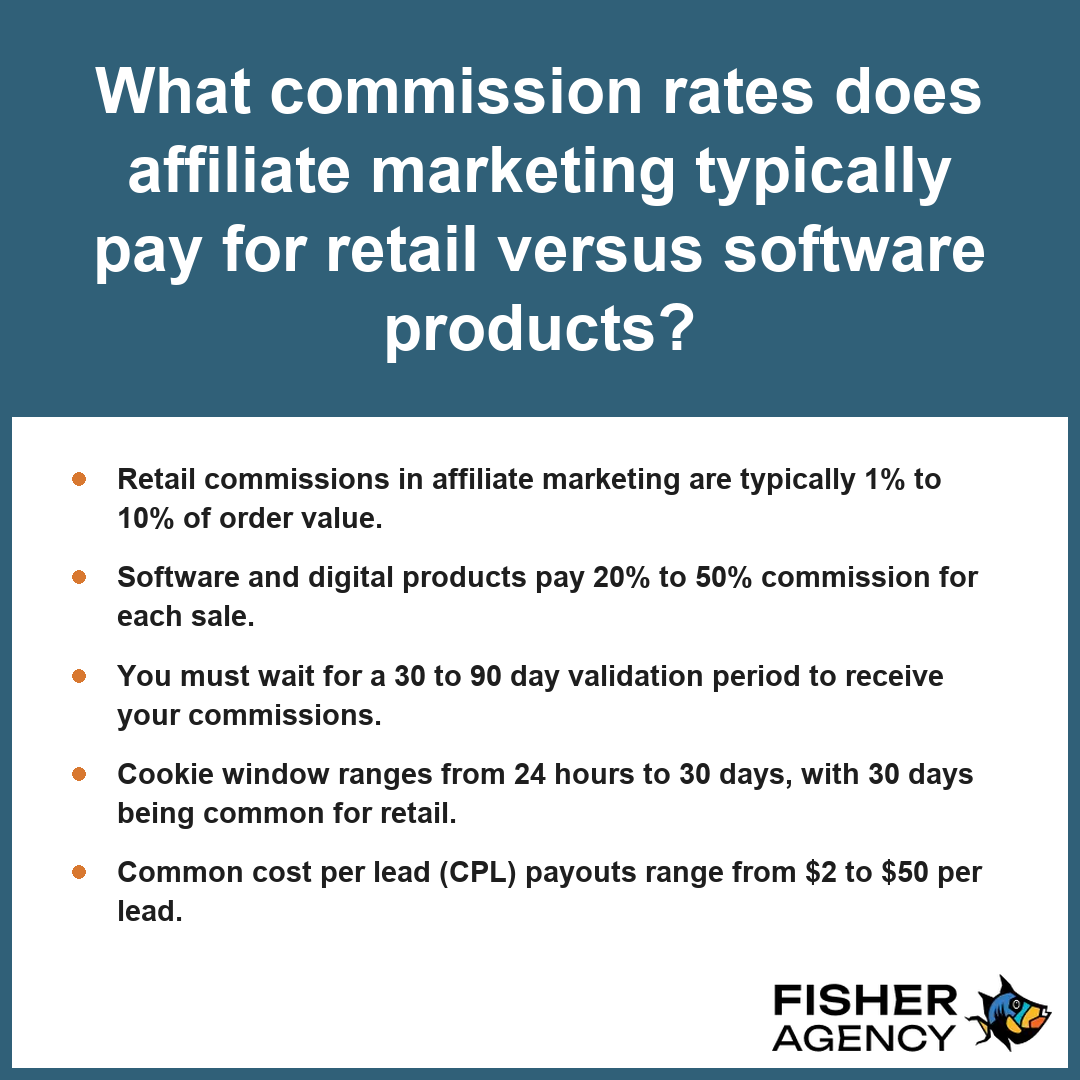
- Retail commissions in affiliate marketing are typically 1% to 10% of order value.
- Software and digital products pay 20% to 50% commission for each sale.
- You must wait for a 30 to 90 day validation period to receive your commissions.
- Cookie window ranges from 24 hours to 30 days, with 30 days being common for retail.
- Common cost per lead (CPL) payouts range from $2 to $50 per lead.
Commission Rates in Affiliate Marketing: Retail Versus Software Products
Commission rates in affiliate marketing are determined by the profit margins and scalability of the product, with retail goods generally offering lower percentages than software and digital offerings.
Typical Affiliate Commission Rates
| Product Category | Typical Commission Rate |
|---|---|
| Retail Goods | 1% to 10% of order value |
| Software and Digital Products | 20% to 50% of order value |
| Subscription Services | 20% to 30% recurring |
Retail programs in affiliate marketing prioritize volume and physical stock, resulting in single-digit commission structures that reflect tighter profit margins. Conversely, software-as-a-service providers and digital product merchants often provide significantly higher rates because their marginal cost of delivery is near zero. Per the Software and Information Industry Association, digital software and SaaS affiliate programs frequently offer commission rates ranging from approximately 20% to 40% due to these lower marginal distribution costs. These programs frequently offer substantial initial payouts or recurring revenue models that pay you for as long as your referred customer maintains an active subscription. While software programs may attract you with higher percentages, the sales cycle for such products is often longer and more complex than for standard retail items.
Evaluate whether a merchant offers a one-time bounty for a software license or a lifetime recurring percentage to determine which model better aligns with your audience’s purchasing behavior.
Consider these additional factors when evaluating the true value of an affiliate commission program:- Cookie Duration: Longer attribution windows increase the likelihood of receiving credit for a conversion, even if the customer waits to purchase.
- EPC (Earnings Per Click): This metric helps determine your actual expected income per click, which is often more indicative of success than just the commission percentage.
- Conversion Rate: Programs with high commission rates but poor site optimization may result in lower actual earnings compared to programs with lower rates but high conversion volumes.
- Refund Policy: Be aware of the merchant’s refund rate, as commissions are typically clawed back if a customer returns the product or cancels their service.
Cost per Sale (CPS), Cost per Lead (CPL), and Cost per Action (CPA) Compared
Cost per sale (CPS), cost per lead (CPL), and cost per action (CPA) represent the distinct performance models used to determine how a merchant compensates an affiliate in affiliate marketing. Each model shifts the financial risk between the merchant and the affiliate based on the depth of the customer interaction required before a payout is triggered.
Typical Payout Upper Limit (USD Equivalent)
| Model | Required Action | Typical Payout Range |
|---|---|---|
| CPS | Completed purchase | 1% to 50% of order value |
| CPL | Form submission or sign-up | $2 to $50 per lead |
| CPA | Specific milestone (e.g., app install) | Varies by program objective |
While CPS is the standard for retail, focusing on completed revenue, CPL prioritizes the acquisition of potential customer data, which is common in finance or insurance programs. CPA offers the most flexibility, allowing merchants to pay for specific behaviors that do not necessarily involve an immediate transaction. Per Interactive Advertising Bureau, the CPA model is generally characterized as a performance-based pricing approach where advertisers compensate partners strictly for a completed transaction or another specific measurable event. You should evaluate whether your traffic converts better through direct purchasing prompts or by funneling users toward non-transactional registrations before committing to a specific program structure.
Consider these strategic factors when selecting the ideal compensation model for your affiliate program:- Assess your current sales cycle length to determine if the affiliate is better suited for high-intent conversion (CPS) or top-of-funnel information gathering (CPL).
- Analyze the lifetime value of a customer to ensure your payout ceilings remain profitable after accounting for affiliate commissions.
- Verify that your internal tracking infrastructure can accurately verify the specific milestones required for CPA models, such as app installs or account activations.
- Conduct A/B testing on landing pages to see if higher conversion rates are achieved through low-friction sign-ups or direct transactional prompts.
How Much Can You Realistically Earn from Affiliate Marketing, and Is It Passive?
Realistically, you can earn from affiliate marketing by leveraging your traffic to generate commissions, though the process requires active maintenance rather than being a purely passive endeavor.
| Performance Variable | Impact on Revenue | Optimization Strategy |
|---|---|---|
| Validation Window | Delays cash flow by 30-90 days | Diversify merchant partners to stagger payouts |
| Conversion Rate | Multiplies EPC efficiency (0.5%–3%) | Target high-intent search queries |
| Traffic Intent | Determines final purchase probability | Focus content on product reviews and comparisons |
| Commission Model | Dictates earnings per action | Align traffic with CPS or high-ticket lead models |
| Niche Authority | Increases click-through rate (CTR) | Build trust to shorten the customer decision cycle |
Affiliate Validation Periods (Days)
What Affects Your Earnings per Click (EPC)
Your ability to monetize traffic depends heavily on the quality of your audience and the relevance of the products you promote. Earnings per click (EPC) is the primary metric for gauging efficiency, measuring the average amount an affiliate earns for every 100 clicks sent to a merchant.
How Conversion Rate Changes Your Results
Because typical conversion rates for affiliate traffic range between 0.5% and 3%, small improvements in your ability to target high-intent users drastically increase your total revenue. Several factors influence these outcomes:
- Traffic intent: Users searching for reviews convert higher than general browsers.
- Commission model: Choosing between cost per sale (CPS) or high-ticket lead generation alters potential gains.
- Seasonality: Promotional timing significantly impacts the volume of purchases.
- Niche authority: Trust built through content correlates with higher click-through rates.
Why Validation Periods Delay Your Payments
Merchants mandate a validation period of 30 to 90 days before commissions are payable to account for returns, order cancellations, or fraudulent activity. This safety window ensures that the merchant does not pay for sales that do not ultimately result in fulfilled revenue. Consequently, even when you record a successful conversion today, the actual payout remains pending within your affiliate network account until the validation cycle concludes.
Is Affiliate Marketing Really Passive?
No, affiliate marketing is not a passive source of income because it requires continuous oversight to remain profitable. While a published article might generate commissions for a period, affiliate programs change terms, merchants expire links, and market competition erodes rankings. To sustain results, you must monitor performance data and minimum payout thresholds, which are typically between $10 and $100.
Analyze your current EPC data to determine if your traffic volume is sufficient to justify the time spent on manual content updates.
To maximize your affiliate revenue, focus on these tactical execution steps:- Implement A/B testing on your call-to-action buttons to identify high-performing placement and color schemes.
- Conduct quarterly audits of your affiliate links to ensure none lead to 404 error pages or expired promotional offers.
- Utilize deep-linking to direct visitors to specific product pages rather than generic merchant homepages.
- Incorporate seasonal tracking parameters to identify which promotional campaigns yield the highest return on investment.
- Monitor your site’s technical load speed, as latency is a primary contributor to lower conversion rates.
How Affiliate Marketing Tracks Sales Through Links, Codes, and Postbacks
How affiliate marketing tracks sales through links, codes, and postbacks involves a multi-layered verification process that ensures a merchant accurately credits an affiliate for driving a specific conversion. By utilizing unique identifiers, the tracking system confirms the origin of a visitor and attributes the resulting action to the correct partner, even when the interaction occurs across different devices or browsers. Per Internet Advertising Bureau, standardized tracking mechanisms like URL parameters and pixel-based postbacks function by passing unique identifiers to the merchant server to ensure accurate attribution of the conversion event to the referring affiliate.
| Tracking Mechanism | Primary Technical Identifier | Data Transmission Point | Primary Use Case | Reliability Level |
|---|---|---|---|---|
| Affiliate Links | URL Parameters (Cookies) | Client-Side Browser | E-commerce Attribution | Moderate (Cookie Dependent) |
| Referral Codes | Alphanumeric Strings | Checkout Input Field | Offline or Ad-Blocker Scenarios | High (Manual Override) |
| Server-to-Server Postbacks | Unique Postback IDs | Merchant-to-Network Server | Mobile Apps and Lead Generation | Maximum (Browser-Agnostic) |
- Affiliate Links: These URLs contain unique parameters that automatically trigger a cookie in the user’s browser, recording the affiliate’s ID to ensure last-click attribution for future sales.
- Referral Codes: Often used when browser-based tracking fails, these alphanumeric strings are entered by the customer during checkout, allowing the merchant to manually assign the commission to the specific affiliate.
- Server-to-Server Postbacks: This method bypasses browser-side limitations by sending conversion data directly from the merchant’s server to the affiliate network, ensuring highly accurate recording of actions like app installs or lead form completions.
- Last-Click Attribution: The standard industry model where the final affiliate link or code interacted with by the customer before a purchase receives full credit for the transaction.
Confirm with your network provider which tracking method is prioritized for your specific offer to ensure that your commissions are not lost due to browser security restrictions or cookie blocking.
Beyond the standard tracking methods, these additional technical considerations influence the efficacy of conversion monitoring:- First-Party Data Integration: Many platforms now utilize first-party cookies to bypass browser-based Intelligent Tracking Prevention (ITP) that limits the lifespan of third-party trackers.
- Fingerprinting Technology: Systems may collect non-identifying browser attributes—such as screen resolution and operating system version—to create a unique user profile when cookies are blocked.
- Attribution Windows: Merchants often configure specific timeframes, such as 30 or 90 days, during which an affiliate remains eligible for a commission after the initial link interaction.
- Deduplication Logic: Tracking systems employ complex algorithms to ensure that a single conversion is not credited to multiple affiliates if a user clicks several distinct referral links before purchasing.
How Long an Affiliate Cookie Lasts in Affiliate Marketing Programs
The cookie window in affiliate marketing defines the duration a tracking file remains active in a user’s browser to ensure an affiliate receives credit for a conversion. When a potential customer clicks your affiliate link, the merchant drops a cookie onto their device. If the customer returns to finalize a purchase before that window expires, the system records the transaction as a result of your referral. Performance Marketing Association reports that affiliate programs in the United States generally rely on these session-based or duration-limited cookies to ensure commissions are tied to the specific lead or sale event generated by the publisher. While specific terms depend on the merchant’s internal policies, durations typically range from 24 hours to 30 days, with 30 days serving as the industry standard for most retail programs.
Typical Cookie Window Durations (in days)
The length of this window significantly influences your chances of earning a commission, as longer periods account for the customer’s natural research and decision-making cycle. Software and finance programs often provide more generous windows compared to physical retail goods to compensate for complex buying journeys. The following table illustrates typical tracking durations by product category:
| Program Category | Typical Cookie Window |
|---|---|
| General Retail | 30 Days |
| Short-term Promotions | 24 Hours |
| Software and SaaS | 60 to 90 Days |
| Finance and Insurance | 60 to 90 Days |
Review the specific terms of service for each program to determine if the merchant uses last-click attribution, which may cause a newer affiliate cookie from a different partner to overwrite your own before the transaction occurs.
To maximize your potential for earning commissions, consider these strategic factors when selecting affiliate programs:- Attribution Model: Verify if the program uses “last-click” attribution, which rewards only the final link clicked before the purchase.
- Cross-Device Tracking: Prioritize merchants that use account-based tracking to ensure you receive credit even if the user clicks on a phone but completes the purchase on a desktop.
- Conversion Rate vs. Duration: Analyze if a shorter window is balanced by a high-converting landing page, which may be more profitable than a long window for a low-converting product.
- Cookie Overwriting Policies: Check if your cookie remains valid if a customer subsequently clicks an affiliate link from a different publisher.
Frequently Asked Questions
Who gets the commission in affiliate marketing when a customer clicks several affiliate links before buying?
The affiliate who owns the final affiliate link clicked before a purchase typically receives the commission under last-click attribution. While some programs employ first-click or multi-touch models to split rewards, most merchants credit the sale to the final affiliate who successfully engaged the customer before the transaction was completed.
Who are the main participants in affiliate marketing, and what types of affiliates exist?
The main participants are the merchant, the affiliate, the customer, and the affiliate network or tracking platform. Various affiliate types exist, including content and review sites, coupon and deal sites, cashback and loyalty programs, email list owners, social media creators, comparison sites, and influencer partners who drive performance-based results.
How and when do affiliate marketing payouts happen, and are they taxed as independent contractor income?
Affiliate marketing payouts occur on monthly cycles once you reach a minimum threshold of about $10 to $100 after a validation period of 30 to 90 days. Because you act as an independent partner, these earnings are generally treated as self-employment income, subject to applicable tax laws for independent contractors.
How do you legally disclose affiliate links in affiliate marketing?
You legally disclose affiliate links by providing a clear, prominent disclosure near the link or content that informs the audience about your financial relationship with the merchant. This notification must be visible before the customer clicks the affiliate link, ensuring transparency regarding your potential commission for the resulting action.
How much does it cost to start affiliate marketing?
Starting affiliate marketing requires low to no initial financial investment, as the model functions by paying affiliates for performance rather than upfront exposure. Costs vary based on your chosen strategy, such as building a website or content platform, but the business model itself is designed as a low-risk acquisition channel.