

Brand Awareness: Measurement, Types, Cost, Channels, Timeline, Digital Proxies, Frequency, Funnel Role, Visual Identity
Brand awareness is the extent to which people recognize or recall a brand and associate it with a product category. Key aspects include types, measurement, channels, cost, digital proxies, timeline, funnel role, frequency, and visual identity. You encounter it in two main forms: recognition, when you identify a brand once you see it, and recall, when you name it without any prompt. Within marketing, it sits at the top of the funnel, because people rarely consider options they do not know exist. A digital marketing and advertising agency typically treats it as a starting objective, planning campaigns around reach, frequency and consistent messaging. This article explains the main types of awareness, how you measure it through surveys and digital proxies such as search volume and social mentions, which channels build it, and what it costs.
Key Takeaways
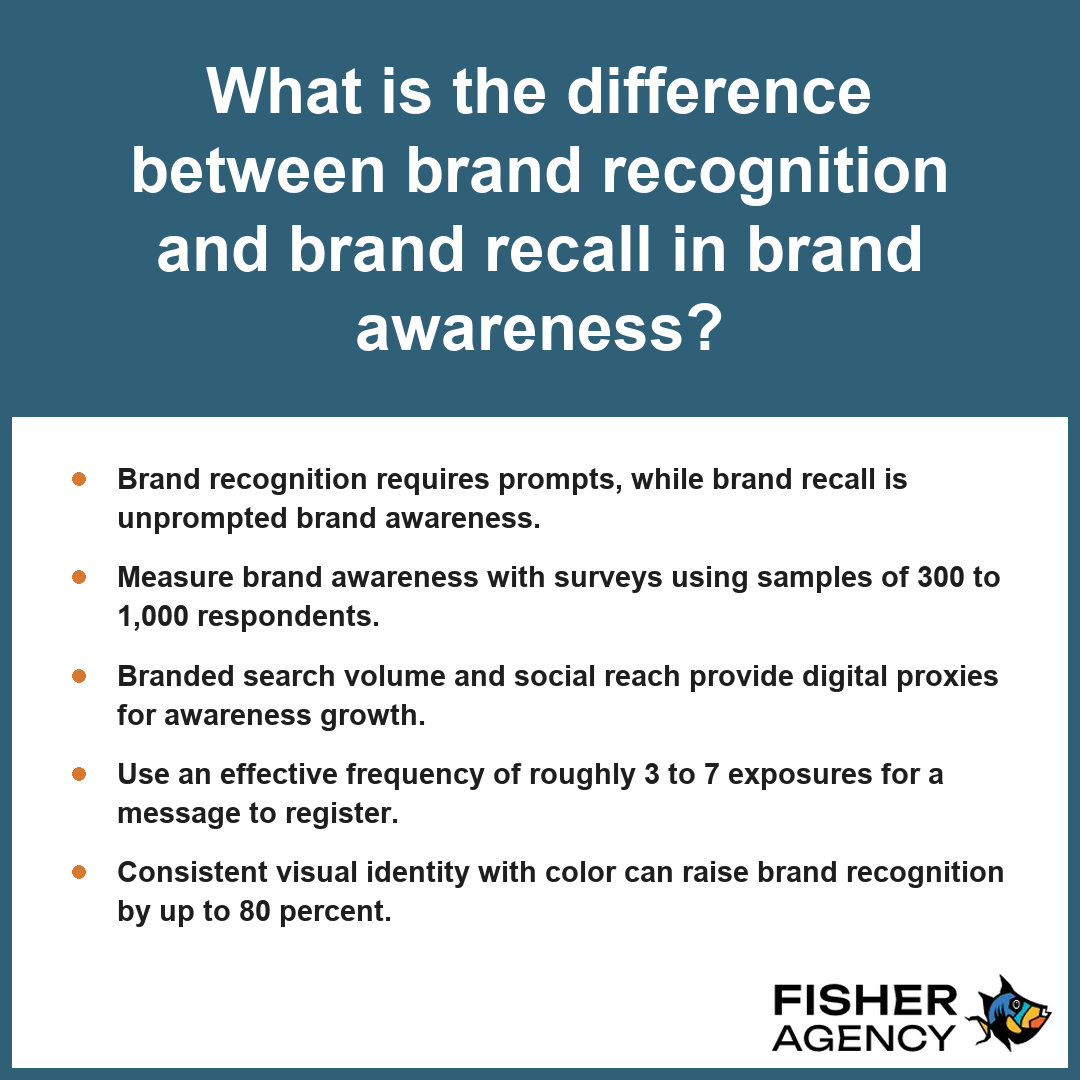
- Brand recognition requires prompts, while brand recall is unprompted brand awareness.
- Measure brand awareness with surveys using samples of 300 to 1,000 respondents.
- Branded search volume and social reach provide digital proxies for awareness growth.
- Use an effective frequency of roughly 3 to 7 exposures for a message to register.
- Consistent visual identity with color can raise brand recognition by up to 80 percent.
What Is the Difference Between Brand Recognition and Brand Recall in Brand Awareness?
In the context of brand awareness, brand recognition is your ability to identify a brand when provided with visual identity or cues, whereas brand recall is your ability to retrieve a brand name from memory without any external assistance. Per the Journal of Marketing, consumer research distinguishes these as two levels of awareness where recognition involves aided retrieval while recall requires unaided cognitive retrieval from memory.
| Metric Category | Cognitive Process | Dependency | Optimization Driver |
|---|---|---|---|
| Brand Recognition | Passive identification via visual/verbal cues | Aided (Requires external stimuli) | Color consistency and visual identity (80% impact) |
| Brand Recall | Active retrieval from internal memory | Unaided (Zero external prompting) | High-frequency repetition (3 to 7 exposures) |
Brand Awareness Metrics
How Brand Recognition Works
Brand recognition is the form of brand awareness where you identify a company only after encountering a visual or verbal cue. It functions as a passive process, relying on external stimuli such as logos, color schemes, or specific taglines to trigger memory. A consistent visual identity is essential here; studies suggest that effective use of color can raise brand recognition by up to roughly 80 percent. When you encounter a familiar logo on a shelf, your brain performs this identification instinctively.
How Brand Recall Works
Brand recall is the more demanding version of brand awareness where you retrieve a brand name from memory without any external prompting. This process occurs when a specific category or consumer need is presented, requiring you to access your internal database of brands. To optimize this, you must rely on high levels of repetition, as the effective frequency usually requires roughly 3 to 7 exposures before a message successfully registers in the consumer’s mind.
Why Top-of-Mind Awareness Matters
Top-of-mind awareness represents the peak of the marketing funnel. It is the specific state where your brand is the very first option a person retrieves when prompted by a product category. The hierarchical progression of these awareness levels is often categorized as follows:
- Unawareness: The consumer has zero knowledge of the brand.
- Brand recognition: Identification occurs only upon exposure to cues.
- Brand recall: The brand is retrieved from memory without prompts.
- Top-of-mind awareness: The brand is the primary choice retrieved.
- Dominance: The brand has become synonymous with the category itself.
Which One Is Harder to Build?
Building brand recall is significantly harder than building brand recognition. While recognition requires only a familiarity with visual cues, recall demands that the brand is deeply embedded in the consumer’s long-term memory. Recognition can often be achieved through short-term campaigns, but moving a brand into the top-of-mind awareness position necessitates a long-term strategy, typically requiring 3 to 12 months or longer to generate measurable growth.
Analyze whether your current campaign budget focuses on driving repeat visual impressions for recognition or the higher-intensity content volume required for recall.
Strategic methods to improve brand performance include the following tactical applications:- Deploy cross-channel consistency: Maintain uniform typography, logo placement, and color palettes across digital ads, packaging, and physical storefronts to lower cognitive load during recognition.
- Target high-intent touchpoints: Place brand assets in environments where the consumer is actively evaluating purchases to maximize the impact of aided retrieval.
- Implement frequency capping: Balance the 3-to-7 exposure threshold by limiting ad impressions to prevent “ad fatigue” while ensuring enough repetition to transition the brand into long-term memory.
- Leverage distinctive assets: Develop unique sonic branding or proprietary shapes that function as standalone recognition triggers, independent of the company logo.
How Brand Awareness Is Measured with Aided and Unaided Surveys
Measuring brand awareness with aided and unaided surveys requires gathering data from a representative sample of your target audience to quantify how recognizable your company is within a specific category. Per American Marketing Association, effective measurement often relies on a combination of both unaided and aided recall techniques to capture a complete picture of top-of-mind salience and broader brand recognition across target demographics. To achieve statistical significance, you should aim for a sample size of 300 to 1,000 respondents, which typically yields a margin of error of about ±3 to ±5 percentage points. These surveys function by assessing different depths of consumer knowledge through structured questioning formats.
| Metric Type | Question Format | Primary Insight | Cognitive Depth |
|---|---|---|---|
| Unaided Awareness | “Which brands come to mind when you think of [Category]?” | Top-of-mind salience | High (Spontaneous Recall) |
| Aided Awareness | “Which of these brands have you heard of?” (List/Logos provided) | Total brand recognition | Moderate (Recognition) |
| Category Association | “Which brand best represents [Specific Need/Value]?” | Mental market share | Specific (Contextual Recall) |
Estimated Timeframes for Measurable Growth (Months)
- Unaided Awareness: Respondents identify your brand without any prompts, which reveals brand recall and provides insight into your top-of-mind awareness.
- Aided Awareness: Respondents are presented with a list of names or logos and asked to identify which ones they recognize, confirming their level of brand recognition.
- Category Association: Surveys often ask participants to link a brand to a specific need or product category to determine how effectively you occupy a space in their memory.
When analyzing your results, you must determine if your brand awareness is growing by comparing current metrics against previous benchmarks. Because these shifts take time, expect that it may take 3 to 12 months or longer to see measurable movement in your survey data. Evaluate your survey intervals against your actual marketing spend to see if your investment is successfully moving consumers along the path from unawareness to top-of-mind status.
Follow these strategic steps to implement and track your brand awareness survey program effectively:- Define specific audience segments to ensure the sample reflects your actual customer base rather than a general population.
- Distribute the survey through multiple channels—such as email newsletters, social media, and third-party panels—to minimize sampling bias.
- Normalize results by benchmarking against historical data or direct competitors to provide necessary context for your percentage gains.
- Analyze the “don’t know” or “refused” response rates to identify potential gaps in brand messaging or market presence.
- Adjust your marketing spend or messaging strategy based on the delta observed between unaided and aided metrics over consecutive quarters.
Best Channels for Building Brand Awareness for a Small Local Business
The best channels for building brand awareness for a small local business are those that maximize reach within your specific community while prioritizing the consistency required to achieve effective frequency. Because awareness builds slowly, often requiring 3 to 12 months or longer to generate measurable movement in your metrics, you should focus on channels that allow for repeated exposure of your visual identity to the same local audience.
| Local Awareness Channel | Primary Mechanism for Reach | Repetition Strategy | Contribution to Brand Authority |
|---|---|---|---|
| Social Media Advertising | Hyper-local geo-targeting | Consistent algorithmic impressions | Visual identity recognition |
| Local SEO | Category-specific search queries | Sustained ranking visibility | Top-of-mind status |
| Sponsorships & PR | Community-based engagement | Recurring physical presence | Neighborhood trust and credibility |
| Online Video | Auditory and visual storytelling | Targeted content sequences | Information retention and recall |
Estimated Timeline for Brand Awareness Impact (Months)
- Social Media Advertising: Use geo-targeted ads to reach local users, as this allows you to control your visual identity and maintain the 3 to 7 exposures necessary for your message to register.
- Search Engine Optimization (SEO): Optimize your online presence for local keywords to ensure your business appears when potential customers are actively searching for your category, a critical step for moving from unrecognized status to top-of-mind awareness.
- Local Sponsorships and Public Relations: Engage in community events or partnerships to build credibility and word of mouth, which acts as a powerful, non-digital multiplier for your total brand awareness. According to the Small Business Administration, local businesses successfully foster neighborhood recognition by establishing a physical presence at community events and participating in local chambers of commerce.
- Online Video and Streaming: Utilize localized video content to leverage the impact of sight and sound, which can improve the memorability of your brand compared to static imagery.
- Direct Digital Display: Deploy banners across locally relevant websites to reinforce your brand name and logo, capitalizing on the potential for color usage to improve brand recognition by up to roughly 80 percent.
Monitor your community engagement rates alongside your traffic sources to determine if your chosen channels are successfully converting casual local impressions into long-term customer recognition.
To maximize the effectiveness of these awareness channels, consider the following tactical focus areas:- Standardize your visual identity across all platforms, ensuring logos, color palettes, and fonts remain identical to reinforce rapid recognition.
- Maintain a centralized database of local customer testimonials to leverage as social proof within your advertising creative.
- Monitor search query data monthly to adjust your SEO keyword strategy based on the specific language used by your local community.
- Allocate a fixed percentage of your marketing budget specifically for recurring sponsorship cycles to guarantee consistent physical presence.
How Much a Brand Awareness Campaign Costs Based on CPM
The cost of a brand awareness campaign is determined by the CPM, which represents the price you pay for every one thousand impressions your advertisements receive. Per the Interactive Advertising Bureau, these campaigns generally rely on CPM pricing models to charge advertisers for every one thousand impressions delivered to their target audience. Because brand awareness requires consistent repetition to reach the necessary effective frequency of 3 to 7 exposures, choosing the right mix of channels is critical for maintaining your budget over the required 3 to 12 months or longer timeframe.
Average CPM by Channel (Midpoint)
| Channel Category | Estimated CPM Range |
|---|---|
| Digital Display | $2 – $10 |
| Social Media | $5 – $15 |
| Video / Connected TV | $15 – $40+ |
Your total expenditure depends on your desired share of voice and the specific media environment where your target audience congregates. While lower CPM options like digital display allow for broad reach, video and connected TV formats often provide higher impact for establishing a visual identity. Review your historical campaign data to determine if you are meeting the effective frequency threshold before increasing your total spend to reach new audience segments.
To optimize your brand awareness budget, follow these strategic steps:- Define your target frequency goal based on whether you are launching a new product or reinforcing an established identity.
- Allocate a testing budget for the first 30 days to identify which specific channels yield the lowest cost per engagement.
- Adjust your total spend incrementally as you gather data on which platforms most effectively drive brand recall.
- Rotate creative assets frequently to prevent ad fatigue and maintain low CPMs within your selected channels.
Can Branded Search Volume and Social Reach Show Whether Brand Awareness Is Growing?
Yes, branded search volume and social reach can serve as functional proxies for tracking whether brand awareness is growing, though they function as indicators of interest rather than direct measures of memory. Branded search volume tracks the frequency with which people actively type your company name into search engines, signaling that your messaging has moved from passive exposure to active intent. Meanwhile, social reach and impressions quantify how many unique users have potentially encountered your content, providing a numerical baseline for how far your visual identity is spreading across digital environments.
| Brand Growth Indicator | Functional Role | Strategic Significance | Validation Requirement |
|---|---|---|---|
| Branded Search Volume | Intent measurement | Converts passive exposure into active consumer inquiry | Sustained upward trend in query frequency |
| Social Reach & Impressions | Exposure quantification | Establishes the breadth of visual identity dissemination | Correlation with engagement depth |
| Follower Growth & Mentions | Identity association | Signals transition from audience awareness to brand affinity | Qualitative analysis of sentiment and context |
Because these metrics are influenced by many variables, consider the following signals to validate growth:
- Branded search volume: A sustained upward trend indicates that your advertising and public relations efforts are successfully driving consumers to seek you out by name. Per Harvard Business Review, increases in branded search queries are a strong signal that top-of-funnel marketing campaigns are successfully turning passive impressions into meaningful brand interest.
- Social reach and impressions: High numbers reflect a broad top-of-funnel exposure, though you must pair this with engagement data to ensure the audience is not just seeing the content but actively processing it.
- Follower growth and social mentions: These provide qualitative depth to your raw reach numbers, suggesting that the audience is not just encountering the brand but beginning to associate with its identity.
Monitor your share of voice alongside these digital proxies to confirm if your growth is outpacing competitors within your specific product category.
To ensure these metrics reflect genuine brand momentum, monitor these secondary indicators:- Direct Traffic Attribution: Observe an increase in users navigating directly to your domain, confirming brand recall independent of search engine referrals.
- Branded Keyword Click-Through Rate (CTR): Monitor the ratio of clicks to impressions on your brand name, which validates the relevance and appeal of your search engine presence.
- Share of Voice (SoV): Compare your search visibility against direct competitors to determine if your brand is gaining a larger portion of the market’s attention.
- Earned Media Velocity: Track the speed and frequency at which third-party publications and influencers reference your brand, serving as an external verification of your authority.
Frequently Asked Questions
How long does it take to build brand awareness in marketing?
Building brand awareness typically requires 3 to 12 months or longer to move tracked metrics measurably. Because gains fade without sustained spending, you must maintain consistent efforts over this period. This slow growth is a standard reality, as awareness serves as the necessary foundation for future consideration and purchase success.
How many times does someone need to see a brand before brand awareness sets in?
A person often needs roughly 3 to 7 exposures, known as effective frequency, before a marketing message registers. While the exact number fluctuates based on your chosen medium and creative quality, repeating your message is essential to move a consumer through the levels of recognition and brand recall.
Does a consistent logo and color palette really improve brand awareness?
Yes, a consistent visual identity including your logo, typography, and color palette significantly improves brand recognition. Research suggests that the strategic use of color can raise brand recognition by up to roughly 80 percent. Maintaining these visual elements helps consumers identify and connect with your brand across various channels.
Where does brand awareness fit in the marketing funnel and why do so few aware people buy?
Brand awareness is the first stage of the marketing funnel and acts as a mandatory prerequisite for consideration and purchase. It is not an immediate sale; rather, it creates the familiarity and trust needed to lower perceived risk, which ultimately helps shorten the decision process for your potential customers.
What is the difference between brand awareness, brand image, and brand equity?
Brand awareness represents the extent to which consumers recognize and recall your identity, while brand equity refers to the broader value derived from that recognition. While awareness is the first stage of the funnel, it must be supported by a strong, positive brand image to successfully drive lasting brand equity.