


Buyer Persona: Research Inputs, Components, Number Needed, Uses, B2B vs B2C Variants, Cost, Interview Volume, Validation, Timeline
A buyer persona is a semi-fictional profile representing a target customer group, built from research and data about real customers. Key aspects include components, research inputs, uses, number needed, cost, B2B vs B2C variants, validation, interview volume, and timeline. Profiles of this kind typically combine demographic details, goals, challenges, and preferred information channels into a single, easy-to-reference description. In marketing, they give teams a shared picture of the audience, which shapes messaging, content topics, and channel choices. When you search for online marketing near me, the results you see reflect how local providers have defined and targeted their own audiences, which shows how persona thinking affects visible campaigns. This article explains the components of a persona, how many you typically need, the research inputs that support them, and the ways you can apply them across marketing work.
Key Takeaways
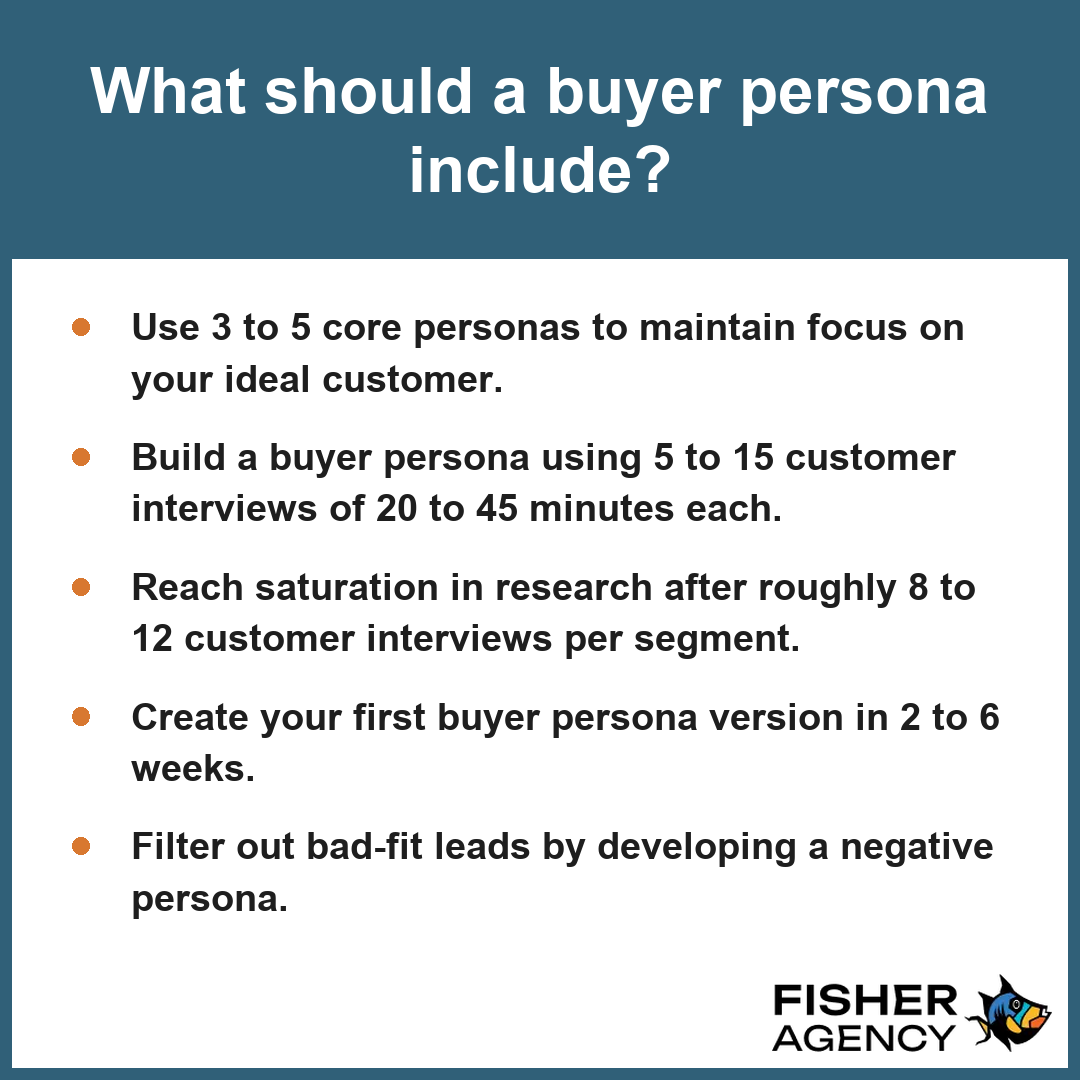
- Use 3 to 5 core personas to maintain focus on your ideal customer.
- Build a buyer persona using 5 to 15 customer interviews of 20 to 45 minutes each.
- Reach saturation in research after roughly 8 to 12 customer interviews per segment.
- Create your first buyer persona version in 2 to 6 weeks.
- Filter out bad-fit leads by developing a negative persona.
What Should a Buyer Persona Include?
A buyer persona includes a comprehensive synthesis of professional and personal attributes that distinguish your ideal customer from the general market. By consolidating qualitative insights and quantitative data, you transform abstract statistics into a functional character profile that highlights specific behaviors, needs, and barriers to entry. Per Harvard Business Review, a buyer persona must include a documented profile of a customer’s specific pain points, professional challenges, and the unique goals they aim to achieve to be truly functional for a marketing strategy.
| Persona Attribute Category | Key Analytical Focus | Strategic Impact on Buyer Journey |
|---|---|---|
| Core Demographics | Mid-market firmographics (50–500 employees) | Defining total addressable market and segmentation |
| Professional Context | Role mapping (Champion, Economic Buyer, Blocker) | Optimizing internal lead qualification and sales velocity |
| Internal Drivers | Primary purchase triggers and performance KPIs | Aligning value proposition with operational imperatives |
| Barriers to Purchase | Friction points and common procurement objections | Developing preemptive risk mitigation strategies |
| Engagement Preferences | Trust-based media channels and content formats | Maximizing touchpoint efficiency and conversion rates |
| Negative Identifiers | Non-qualified cohorts (job seekers, low-budget leads) | Refining marketing spend efficiency and focus |
B2B Buyer Persona: Company Size Range (Employees)
- Core Demographics: Age, location, job title, industry, annual income, or, for B2B, company size (50 to 500 employees) and annual revenue.
- Professional Context: Detailed decision roles such as champion, economic buyer, influencer, end user, or blocker, along with budget authority.
- Internal Drivers: Clear goals, motivations, and the specific purchase triggers that initiate the search for a solution.
- Barriers to Purchase: Persistent pain points and common objections that cause friction during the transition through the buyer journey.
- Engagement Preferences: The information channels and media types the buyer trusts for professional or personal discovery.
- Negative Persona Characteristics: Explicit identifiers for non-customers, such as job seekers or those lacking budget, to ensure precise marketing focus.
Audit your existing documentation to ensure you have captured at least one unique negative persona alongside your core personas to prevent wasting resources on unqualified prospects.
To operationalize these personas, follow this workflow to integrate them into your active sales cycle:- Map persona-specific pain points to existing case study collateral to demonstrate relevant social proof.
- Audit current CRM data fields to ensure lead scoring reflects the professional role and internal drivers identified.
- Develop a library of objection-handling scripts tailored to the specific barriers listed in your profile.
- Synchronize content distribution channels with the identified trust-based media preferences of the persona.
- Establish a quarterly feedback loop between sales and marketing to validate if current persona assumptions align with closing win/loss patterns.
How Many Buyer Personas Does a Business Actually Need?
You should typically develop 3 to 5 core personas to effectively represent your ideal customer segments across the buyer journey, while also considering the inclusion of a negative persona to clarify who does not fit your business model.
| Strategic Persona Type | Recommended Quantity | Operational Rationale |
|---|---|---|
| Core Buyer Personas | 3 to 5 | Balances audience specificity with internal resource scalability. |
| Negative Persona | 1 | Eliminates misaligned prospects to optimize sales efficiency. |
| Total Portfolio Limit | Maximum 6 | Prevents marketing dilution and diminishing marginal utility. |
Recommended Persona Count
How Many Core Personas Fit Most Businesses?
Most businesses require 3 to 5 core personas to maintain a balance between specific targeting and operational efficiency. Attempting to manage more than 5 often dilutes your marketing focus, while relying on a single profile frequently oversimplifies the diverse needs of your ideal customer base. Per the Marketing Science Institute, firms eventually encounter diminishing marginal utility from adding too many personas, as the cost of managing distinct strategies begins to outweigh the benefits of hyper-granular targeting. By focusing on this specific range, you ensure that your messaging resonates with your most valuable audience segments without overwhelming your internal resources.
Segmentation Factors That Change the Count
The number of buyer persona profiles you develop depends on the complexity of your offerings and the variety of your market segments. Organizations that serve multiple industries or maintain distinct product lines often find that adding more profiles improves the precision of their communication. Consider the following variables when determining your internal requirements:
- Decision role complexity: Distinguishing between end users, influencers, and economic buyers.
- Business size variations: Creating separate profiles for small teams versus enterprises with 50 to 500 employees.
- Geographic or cultural nuances: Accounting for differences in regional buying habits or lifestyle values.
- Technical maturity levels: Segmenting between early adopters and those who require significant educational hand-holding.
When Does a Negative Persona Earn a Place?
A negative persona earns a place in your documentation when you need to actively filter out individuals who are not a fit, such as job seekers, students, or prospects with insufficient budgets. By explicitly defining these non-buyers, you protect your sales team from wasting time on unproductive leads and refine your ad targeting to exclude irrelevant traffic. Including these profiles ensures that your outreach remains disciplined and centered exclusively on your most profitable opportunities.
Audit your current lead acquisition data to identify which groups consistently fail to convert, as these patterns will signal exactly where you need to implement a negative persona to refine your future efforts.
Consider these additional variables that justify adjusting your total persona count beyond the baseline recommendations:- Market Complexity: B2B models with multi-stakeholder buying committees often require more personas than B2C transactional models.
- Product Portfolio Breadth: Companies offering distinct product lines that serve unrelated job functions may need additional profiles to maintain relevance.
- Sales Cycle Duration: Longer, high-touch sales cycles benefit from granular personas that address specific objections at every stage of the funnel.
- Internal Capability: Your team’s capacity to produce tailored content for each segment determines the practical ceiling for your persona count.
Data Sources for Building a Buyer Persona Instead of Guessing
Data sources for building a buyer persona instead of guessing rely on gathering verifiable evidence from your existing customer base and market interactions to create a research-based profile of an ideal customer. Rather than relying on assumptions, you should aggregate qualitative and quantitative inputs to ensure the resulting buyer persona accurately reflects motivations, pain points, and purchase triggers.
| Data Source Category | Primary Research Objective | Metric/Output Goal |
|---|---|---|
| Customer Interviews | Identify motivations and core pain points | Achieve saturation (8-12 sessions per segment) |
| CRM & Sales Logs | Map recurring objections and purchase triggers | Actionable sales enablement insights |
| Digital Analytics | Observe objective behavioral patterns | Device, content, and engagement profiles |
| Win/Loss Reviews | Determine conversion drivers and deal-breakers | Quantitative conversion intelligence |
| Negative Persona Data | Define poor-fit prospect traits | Reduction in unproductive sales pipeline activity |
Customer Interview Ranges
- Customer interviews: Conduct 5 to 15 sessions, each lasting 20 to 45 minutes, until you reach saturation, which typically occurs after roughly 8 to 12 interviews per segment.
- Sales and Support Data: Review CRM records, sales call recordings, and support tickets to identify common objections and recurring challenges faced by prospects.
- Digital Analytics: Use web and social media analytics to observe actual behavior, device preferences, and content engagement patterns.
- Market Research Inputs: Incorporate survey results and win/loss reviews to understand why specific leads converted while others did not.
- Negative Persona Identification: Analyze data to define traits of poor-fit prospects—such as those with insufficient budgets or mismatched needs—to ensure they are excluded from your targeting strategy.
Review your CRM data for recent lost deals to see if you can identify a new negative persona that currently consumes your sales team’s time.
To refine your buyer persona development, consider integrating these supplementary data streams to increase granular accuracy:- Social Listening: Monitor industry-specific forums, LinkedIn groups, and Reddit threads to capture unfiltered prospect sentiment and language.
- Customer Support Tickets: Analyze common technical roadblocks or post-purchase friction points that internal teams often overlook.
- Competitor Benchmarking: Evaluate public customer testimonials for rival products to identify gaps in their service that your persona might value.
- Heatmap and Session Replay Data: Observe actual user interaction with your website to confirm if intent aligns with reported navigation behavior.
How to Use a Buyer Persona in Marketing, From Content to Email Segmentation
Using a buyer persona in marketing involves tailoring every touchpoint to match the specific motivations, decision roles, and pain points of your ideal customer, ensuring your messaging resonates deeply with their professional or personal needs. By applying this research-based profile, you move away from broad, generic outreach toward precise strategies that address the specific purchase triggers and information sources your target audience actually uses. Per the Journal of Marketing, evidence indicates that content marketing strategies customized to the pain points and decision-making drivers of specific personas generate higher engagement and conversion rates within the United States market.
| Strategic Application | Primary Persona Driver | Execution Tactic | Metric of Impact |
|---|---|---|---|
| Content Strategy | Knowledge Gaps & Pain Points | Targeted White Papers | Engagement Depth |
| Email Segmentation | Organizational Decision Roles | Role-Specific Messaging | Conversion Velocity |
| Ad Targeting | Media Consumption Habits | Platform-Specific Parameters | Cost-Per-Acquisition |
| Sales Enablement | Internal Procurement Hurdles | Objection-Handling Scripts | Lead-to-Close Ratio |
| Negative Persona Filtering | Resource Misalignment | Inclusion/Exclusion Logic | Qualified Lead Quality |
- Content Strategy: Develop long-form guides, blog posts, and white papers that directly address the specific challenges and pain points identified in the persona profile.
- Email Segmentation: Categorize your contact lists based on the persona’s job title, company size (such as organizations with 50 to 500 employees), or industry, sending tailored sequences that speak to their unique decision-making role.
- Ad Targeting: Configure paid media parameters to mirror the demographics, lifestyle, and device usage of your ideal customer, avoiding wasted spend on segments that do not align with your product.
- Sales Enablement: Equip your sales team with scripts and objection-handling guides that reflect the common hurdles and internal pressures faced by that specific buyer persona.
- Negative Persona Filtering: Use criteria to identify and exclude individuals—such as those with a budget that is too small or those seeking free tools—to ensure your team focuses resources on high-intent prospects.
Audit your current automated email workflows to confirm that every message variation aligns with a distinct pain point found in your primary buyer persona documentation.
To operationalize these persona-driven insights effectively, follow these specific implementation steps:- Conduct quarterly interviews with current customers to validate that the documented pain points still align with evolving market challenges.
- Map each buyer persona to specific stages of the sales funnel to ensure content relevance from awareness through to final decision-making.
- Audit existing marketing collateral to identify and remove jargon or value propositions that do not directly address the identified decision roles.
- Establish feedback loops between the sales and marketing departments to refine persona profiles based on real-world objection trends.
- Perform A/B testing on call-to-action language to determine which specific triggers most effectively influence different persona archetypes.
How to Map a Buyer Persona to the Awareness, Consideration, and Decision Stages of the Buyer Journey
Mapping a buyer persona to the awareness, consideration, and decision stages of the buyer journey involves aligning your messaging and content strategy with the specific needs of your ideal customer at every transition point. By layering the persona’s pain points and decision roles onto the progression of the buyer journey, you ensure that every interaction provides the exact information required to move the prospect closer to a purchase.
| Buyer Journey Stage | Persona Pain Point Focus | Strategic Objective | Content/Evidence Requirement | Decision Role Targeted |
|---|---|---|---|---|
| Awareness | Initial symptoms and underlying triggers | Educational authority building | Broad industry insights and problem-scope analysis | The Researcher / Initiator |
| Consideration | Specific comparative objections | Category solution positioning | Evaluation criteria and competitive differentiation | The Evaluator / Influencer |
| Decision | Final justification hurdles | Commitment securement | Technical specifications and ROI case studies | The Economic Buyer / Budget Holder |
| Exclusion | Non-ideal/unqualified attributes | Active disqualification | Boundary-defining constraints and usage limiters | The Misaligned Prospect |
- Awareness Stage: Focus on the buyer persona’s initial symptoms or primary challenges. Use content to educate the reader on the scope of their pain points without pushing a specific solution, establishing authority by addressing the triggers that initiated their search.
- Consideration Stage: Present your offer as a viable category solution. Address the specific objections and information sources identified in your buyer persona profile to help the prospect evaluate your product against others.
- Decision Stage: Transition to product-specific details and proof. Per the American Marketing Association, successful decision stage content must provide specific evidence, such as technical specifications or case studies, to help the persona justify the final purchase choice. Highlight the specific decision roles—such as the economic buyer or the influencer—and provide the technical evidence or budget justifications needed to secure a final commitment.
- Exclusion: Integrate your negative persona traits during the mapping process to identify where your messaging should actively deter unqualified prospects, such as those seeking free tools or individuals outside your target company size of 50 to 500 employees.
Audit your existing content library to verify whether each asset explicitly serves one specific persona at a single, identified stage of their transition.
To optimize your content strategy across the buyer journey, consider these additional tactical implementation steps:- Conduct sentiment analysis on support tickets to identify the specific vocabulary buyers use to describe their pain points.
- Map existing collateral to your funnel stages to identify and fill critical content gaps in your middle-of-funnel assets.
- Implement lead scoring triggers that automatically adjust messaging based on the frequency and type of content a prospect consumes.
- Analyze conversion drop-off rates between stages to determine if your content is successfully transitioning the prospect to the next decision role.
Frequently Asked Questions
How many customer interviews are enough to create a buyer persona?
You should conduct between 5 to 15 customer interviews to create a buyer persona. While this range provides a strong foundation, you will typically reach a point of saturation where new information stops appearing after roughly 8 to 12 interviews per segment.
How much does it cost to hire an agency to create a buyer persona?
Hiring an agency to conduct a buyer persona research project typically costs between $1,500 and $15,000. These fees cover the professional labor required to gather and synthesize data from your ideal customer base, while in-house development focuses primarily on the investment of your own staff time.
How long does it take to build a buyer persona, and how often should it be updated?
Building a first version of a buyer persona usually takes 2 to 6 weeks. You should review your profiles at least once a year, or sooner if you undergo a significant product launch, a pricing change, or a major market shift that alters your ideal customer behavior.
How is a B2B buyer persona different from a B2C buyer persona?
A B2B buyer persona focuses on professional factors like company size of 50 to 500 employees, decision role, and budget authority. In contrast, a B2C buyer persona emphasizes personal characteristics such as household income, life stage, lifestyle, values, and individual shopping habits or device usage.
How do you validate that a buyer persona is accurate?
You validate that a buyer persona is accurate by basing it on research inputs including customer interviews, surveys, CRM data, and win/loss reviews. These objective data sources ensure the profile represents your ideal customer rather than assumptions, effectively guiding your messaging throughout every stage of the buyer journey.