

Target Audience: Research Methods, Segmentation Types, Market Distinction, Firmographics, Size, Personas, Performance Metrics, Channel Fit, Data and Privacy

A target audience is the specific group of people a marketing message, product, or campaign is designed to reach. Key aspects include segmentation types, research methods, firmographics, market distinction, personas, size, channel fit, performance metrics, and data and privacy. In marketing, this group shapes decisions about messaging, channels, timing, and budget, because a message built for everyone rarely resonates with anyone. Segmentation types such as demographic, geographic, psychographic, and behavioral divisions break a broad market into smaller groups with shared traits. Firmographics apply the same logic to business audiences, using attributes like company size, industry, and revenue. Searches such as digital marketing companies near me show how location and intent can define a segment, and market distinction explains how one audience differs from another. The article also covers research methods, including surveys, interviews, and analytics, and the way personas turn findings into practical profiles you can apply to planning.
Key Takeaways
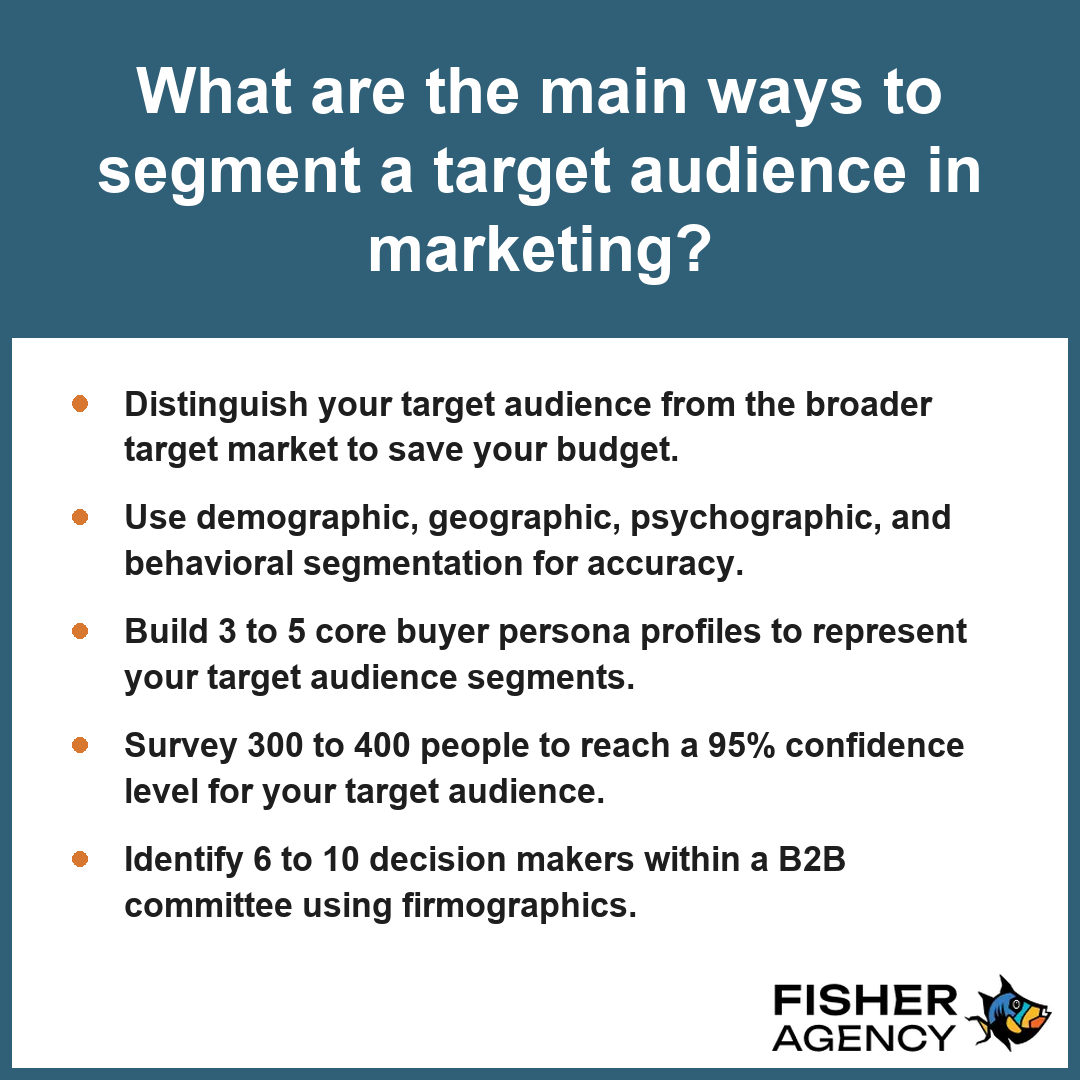
- Distinguish your target audience from the broader target market to save your budget.
- Use demographic, geographic, psychographic, and behavioral segmentation for accuracy.
- Build 3 to 5 core buyer persona profiles to represent your target audience segments.
- Survey 300 to 400 people to reach a 95% confidence level for your target audience.
- Identify 6 to 10 decision makers within a B2B committee using firmographics.
What Are the Main Ways to Segment a Target Audience in Marketing?
The main ways to segment a target audience in marketing rely on four primary categories that organize individuals based on shared characteristics, helping you tailor your communications to specific needs and behaviors.
| Customer Tier | Revenue Contribution | Segmentation Focus | Strategic Application |
|---|---|---|---|
| Top 20% (Core Segment) | 80% of Total Revenue | Behavioral & Psychographic | Retention, loyalty rewards, and high-value experience optimization |
| Remaining 80% (Broad Segment) | 20% of Total Revenue | Demographic & Geographic | Acquisition, mass-market awareness, and demographic expansion |
Revenue Concentration: Top Customers
- Demographic segmentation: Organizes your target audience by quantifiable attributes such as age, gender, education, family status, occupation, and financial capacity, including factors like the $80,610 median household income.
- Geographic segmentation: Divides your target audience by location, utilizing variables such as ZIP codes, cities, states, climate, urban versus rural settings, or broad regional designations like the 210 Nielsen Designated Market Areas.
- Psychographic segmentation: Focuses on the internal drivers of your target audience, including values, attitudes, interests, and lifestyle choices, which are often uncovered through direct surveys or social listening.
- Behavioral segmentation: Tracks how your target audience interacts with your offering by analyzing purchase history, brand loyalty, usage rates, and progression through the buying journey, keeping in mind that roughly 80% of revenue often comes from the top 20% of your customers. According to Harvard Business Review, this approach involves examining purchasing habits, brand loyalty, usage rates, and the specific benefits users seek from a product.
Review your historical customer data to see which of these four segments demonstrates the highest lifetime value before allocating your upcoming campaign budget.
Effective audience segmentation can be further refined by implementing these tactical approaches to improve data accuracy and campaign performance:- First-Party Data Collection: Use direct interactions like website cookies, login data, and purchase history to build precise user profiles rather than relying on third-party estimates.
- A/B Testing Variables: Run split tests on different segments to determine which specific psychographic triggers or demographic messaging resonate best with your unique customer base.
- Predictive Modeling: Utilize machine learning algorithms to forecast future purchasing behavior based on historical trends, allowing you to proactively target customers before they churn.
- Dynamic Content Personalization: Implement website modules that automatically adjust copy and imagery in real-time based on the user’s geographic location or previous browsing behavior.
Is a Target Audience the Same as a Target Market?
No, a target audience is not the same as a target market because a target market encompasses the broad group of potential buyers who have the ability and willingness to purchase your product, whereas a target audience refers specifically to the narrower, focused segment of that market you intend to reach with a particular marketing message.
| Strategic Layer | Functional Breadth | Primary Marketing Role | Volatility |
|---|---|---|---|
| Target Market | Total addressable pool of viable buyers | Defines product-market fit and business viability | Stable |
| Primary Audience | High-intent subset prioritized for conversion | Direct focus of immediate campaign budget | Dynamic |
| Secondary Audience | Niche segment with peripheral relevance | Supports growth via tailored messaging | Dynamic |
How Does a Target Market Differ in Scope From a Target Audience?
No, a target audience is not the same as a target market, as the two terms represent distinct levels of scale and specificity in your strategic planning. Per the American Marketing Association, a target market is the broader group of customers identified via segmentation, while a target audience is the specific subset of that market targeted by a particular campaign. A target market defines the total potential pool of buyers for your product or service, encompassing everyone who possesses the means and the need to purchase from you. In contrast, a target audience is a refined, actionable slice of that market, prioritized for a specific campaign, channel, or message. While your target market remains relatively stable, your target audience shifts depending on the goal of your current marketing activity.
Where Do Primary Audience and Secondary Audience Fit?
- Target Market: The broad universe of potential customers defined by fundamental market viability.
- Primary Audience: The main group currently prioritized for the highest conversion rates and campaign budget allocation.
- Secondary Audience: A supporting segment that shares relevant traits but requires a different value proposition or lower resource investment.
Why Does the Distinction Matter for Your Budget?
The distinction between these two concepts is critical because your budget efficiency relies on the precision of your reach. Targeting your entire target market at once often leads to diluted messaging and wasted ad spend on individuals who are not currently ready to buy. By narrowing your focus to a specific target audience, you avoid burning through your budget by reaching those least likely to convert. Furthermore, many advertising platforms require a minimum audience size—often about 1,000 to 10,000 people—to provide enough data for algorithmic optimization. If you keep your scope too broad, your data becomes noisy; if it is too narrow, you fail to reach the threshold required for automated performance scaling.
Audit your current ad platform settings to confirm that your active segments meet the minimum threshold for algorithmic optimization without overspending on irrelevant prospects.
To clarify the operational differences between these two concepts, consider these distinct characteristics:- Data Basis: Target markets are typically derived from broad demographic, geographic, and psychographic segmentation, whereas target audiences are often defined by behavioral data and immediate intent signals.
- Messaging Strategy: Target market strategy focuses on positioning and branding to remain relevant over time, while target audience strategy focuses on personalization and specific calls to action.
- Success Metrics: Success for a target market is measured by overall market share and brand penetration, while success for a target audience is measured by conversion rates and campaign-specific ROI.
How to Find Your Target Audience Using Interviews, Surveys, and Analytics
Finding your target audience requires a blend of qualitative insights and quantitative data to move beyond broad assumptions and identify the specific people most likely to engage with your offerings. By triangulating direct feedback with platform performance metrics, you build a foundation for precise, effective messaging.
| Research Method | Recommended Sample Size | Primary Insight Value | Data Confidence & Reliability |
|---|---|---|---|
| Primary Interviews | 5–15 per segment | Individual motivations and pain points | High qualitative depth |
| Large-scale Surveys | 300–400 responses | Market-wide sentiment patterns | ±5% margin of error (95% confidence) |
| CRM Data Mining | Top 20% of customer base | Revenue-driving behavioral clusters | High historical accuracy |
| Platform Analytics | 1,000–10,000 users | Demographic and interest trends | Statistical relevance for ad delivery |
Recommended Sample Sizes for Audience Research
- Conduct primary interviews: Perform 5 to 15 in-depth customer interviews per segment to uncover individual motivations, pain points, and specific language used to describe your product.
- Deploy large-scale surveys: Execute surveys to collect 300 to 400 responses, which provides a ±5% margin of error at a 95% confidence level, ensuring your findings are statistically significant. According to the National Institute of Standards and Technology, statistical analysis of consumer datasets requires rigorous data cleaning and validation procedures to remove noise and ensure that insights are representative of the target user base.
- Mine first-party data: Analyze your existing CRM and sales records to identify high-value clusters, applying the principle that the top 20% of your customers often produce roughly 80% of your revenue.
- Leverage platform analytics: Utilize tools like web analytics or advertising platform insights to extract objective data on age, interest, and behavior, ensuring your segments reach a minimum scale of about 1,000 to 10,000 people for optimal campaign delivery.
- Perform competitor analysis: Evaluate how market rivals position themselves to identify gaps or overlapping interests within your broader market.
Before launching a campaign, verify that your identified segment is large enough to allow for algorithmic optimization while remaining narrow enough to maintain high relevance.
To refine your research strategy, consider incorporating these additional practical steps:- Analyze competitor social media interactions to identify gaps in existing audience engagement.
- Monitor search intent queries to map the specific problems potential users are actively trying to solve.
- Audit existing customer support tickets to categorize recurring friction points and feature requests.
- Perform A/B testing on messaging variations to validate which value propositions resonate most effectively with identified segments.
How to Turn Target Audience Data Into a Buyer Persona (and How Many You Need)
Turning target audience data into a buyer persona involves synthesizing raw demographic, behavioral, and psychographic research into a singular, relatable profile that represents a specific segment of your market. This process bridges the gap between statistical trends and the human motivations driving purchase decisions. Per the Journal of Marketing, firms typically find that using 3 to 5 personas is optimal, as developing too many can create unnecessary operational complexity without offering significant improvements in targeting precision.
| Strategic Persona Component | Functional Purpose | Data Integration Source |
|---|---|---|
| Demographic Foundation | Establishes the objective baseline for reach and accessibility | CRM entries and existing customer database |
| Psychographic Drivers | Uncovers the emotional catalysts behind purchase intent | Qualitative survey responses and interview transcripts |
| Behavioral Pain Points | Pinpoints friction areas for targeted solution mapping | Web analytics and user engagement session recordings |
| Communication Preferences | Optimizes channel allocation for maximum conversion impact | Historical campaign performance and click-through metrics |
Recommended Number of Buyer Personas
- Identify dominant patterns: Examine your collected data—such as CRM entries, survey responses, and web analytics—to find recurring challenges, professional goals, or lifestyle habits.
- Draft the profile: Assign a name and job title to the persona, then outline their specific pain points, preferred communication channels, and primary objections to your product or service.
- Humanize the narrative: Write a brief biography that explains why this person would interact with your brand, focusing on the outcomes they hope to achieve.
- Validate against reality: Review your draft against your existing first-party data to ensure the persona accurately reflects the motivations of your actual customers.
- Refine for action: Use the completed profile to inform creative messaging, ensuring it speaks directly to the specific goals and obstacles you identified during the creation process.
Validate your established buyer personas by cross-referencing their specific objections against your current sales closure logs to see if the profile predicts real-world friction points.
Follow these steps to synthesize your raw research into actionable buyer profiles:- Cluster qualitative insights into thematic groups to identify common motivations and recurring objections.
- Draft a narrative biography for each persona that contextualizes their professional goals and personal values.
- Validate your profiles by cross-referencing them with current sales team feedback and actual lead conversion data.
- Assign a descriptive name and a representative photograph to each profile to increase team empathy and internal memorability.
- Update your personas quarterly to account for shifts in market conditions and evolving consumer expectations.
How Do You Define a Target Audience for a B2B Company Using Firmographics?
You define a target audience for a B2B company using firmographics by mapping the organizational characteristics and specific professional roles that align with your product’s value proposition. Unlike consumer marketing, which relies heavily on individual demographics, B2B strategies require you to identify the structural makeup of the businesses you serve to ensure your messaging reaches the appropriate decision-making hierarchy.
| Firmographic Criterion | Strategic Objective | Primary Metric for Segmentation |
|---|---|---|
| Industry Classification | Identify vertical-specific pain points | NAICS Code alignment |
| Organizational Scale | Verify product-price fit | Annual Revenue / Employee Count |
| Buying Committee Composition | Address multi-stakeholder objections | Decision-maker count (6–10) |
| Operational Location | Ensure delivery and compliance | Territorial infrastructure capacity |
| Technographic Status | Gauge integration compatibility | Current software stack/ecosystem |
B2B Buying Committee Size
- Industry Classification: Utilize standard industry codes to filter companies that have an established need for your specific solution. Per the U.S. Census Bureau, the North American Industry Classification System serves as the standard federal framework for categorizing business entities by their primary economic activity for the purpose of firmographic segmentation.
- Organizational Scale: Evaluate prospective accounts based on annual revenue or total employee count to match your offering’s complexity and pricing model.
- Buying Committee Composition: Account for the fact that a typical B2B buying committee includes 6 to 10 decision makers, each requiring tailored content to address their unique professional objections.
- Operational Location: Narrow your focus to specific geographic territories where your logistics, legal compliance, or service teams are best equipped to deliver results.
- Technographic Status: Assess the software or infrastructure stack currently in use to determine if a prospect possesses the prerequisite environment for your target audience.
Audit your current CRM data to see if your most profitable accounts cluster within specific revenue brackets or industry sectors before expanding your outreach efforts.
Follow these additional steps to refine your target audience segmentation:- Analyze historical CRM data to identify which firmographic attributes correlate most strongly with the shortest sales cycles.
- Monitor trigger events, such as executive leadership changes or recent funding rounds, to prioritize high-intent accounts.
- Conduct whitespace analysis to detect gaps in a prospect’s current technology stack that your solution can uniquely fill.
- Align your lead scoring model with the specific decision-making hierarchy identified in your buying committee research.
Frequently Asked Questions
What is the difference between a primary and secondary target audience?
A primary audience consists of the most valuable, high-propensity buyers for your campaign, while a secondary audience represents adjacent groups with lower, yet still relevant, potential. The primary audience is your focus for core messaging and optimization, whereas the secondary audience allows for broader reach or niche experimentation.
How narrow should a target audience be before ad platforms can’t optimize?
A target audience should remain above a size of about 1,000 to 10,000 people to ensure ad platforms have sufficient data to optimize performance. While narrowing your focus reduces wasted impressions and lowers acquisition costs, shrinking below this threshold often prevents ad systems from delivering consistent results or meaningful insights.
Which channels work best for reaching a target audience by generation?
Older adults are best reached through email, television, and Facebook, while younger generations are more effectively engaged via TikTok, Instagram, and YouTube. You must align your message and channel choice with the specific media consumption habits and digital behaviors inherent to your chosen age-based segment.
How do you test whether you chose the right target audience using CTR, conversion rate, and A/B tests?
You test a target audience by running A/B tests to compare CTR and conversion rates across different segments to determine which group responds best to your creative. Consistently higher engagement metrics indicate a better fit, allowing you to refine your approach and maximize returns from your top-performing segments.
How do privacy laws and the end of third-party cookies change how you build a target audience?
Privacy changes require you to shift toward building your target audience using first-party data, CRM insights, and direct customer interactions. By prioritizing these owned data sources over third-party tracking, you ensure compliance while maintaining the accuracy needed to define demographics, behaviors, and psychographic segmentation for your marketing campaigns.