


Niche Market: Profit Margin, Size, Validation Process, Acquisition Channels, Customer Spend, Defining Criteria, Positioning, Competition, Risks and Growth, Customer Loyalty

A niche market is a narrowly defined segment of a larger market whose customers share specific needs, preferences, or characteristics. Key aspects include size, profit margin, acquisition channels, validation process, defining criteria, customer spend, competition, positioning, customer loyalty, and risks and growth. You can recognize this kind of segment by the focused demand it shows and by the limited number of suppliers that serve it. Within marketing, it lets you concentrate messaging, product features, and pricing on one well-understood group instead of a broad audience. Work on such a segment is often handled by a marketing agency that specializes in a particular industry or customer type, though in-house teams do the same research. This article explains the defining criteria, typical size, profit margin patterns, acquisition channels, and the validation process you can use to test whether demand is real.
Key Takeaways
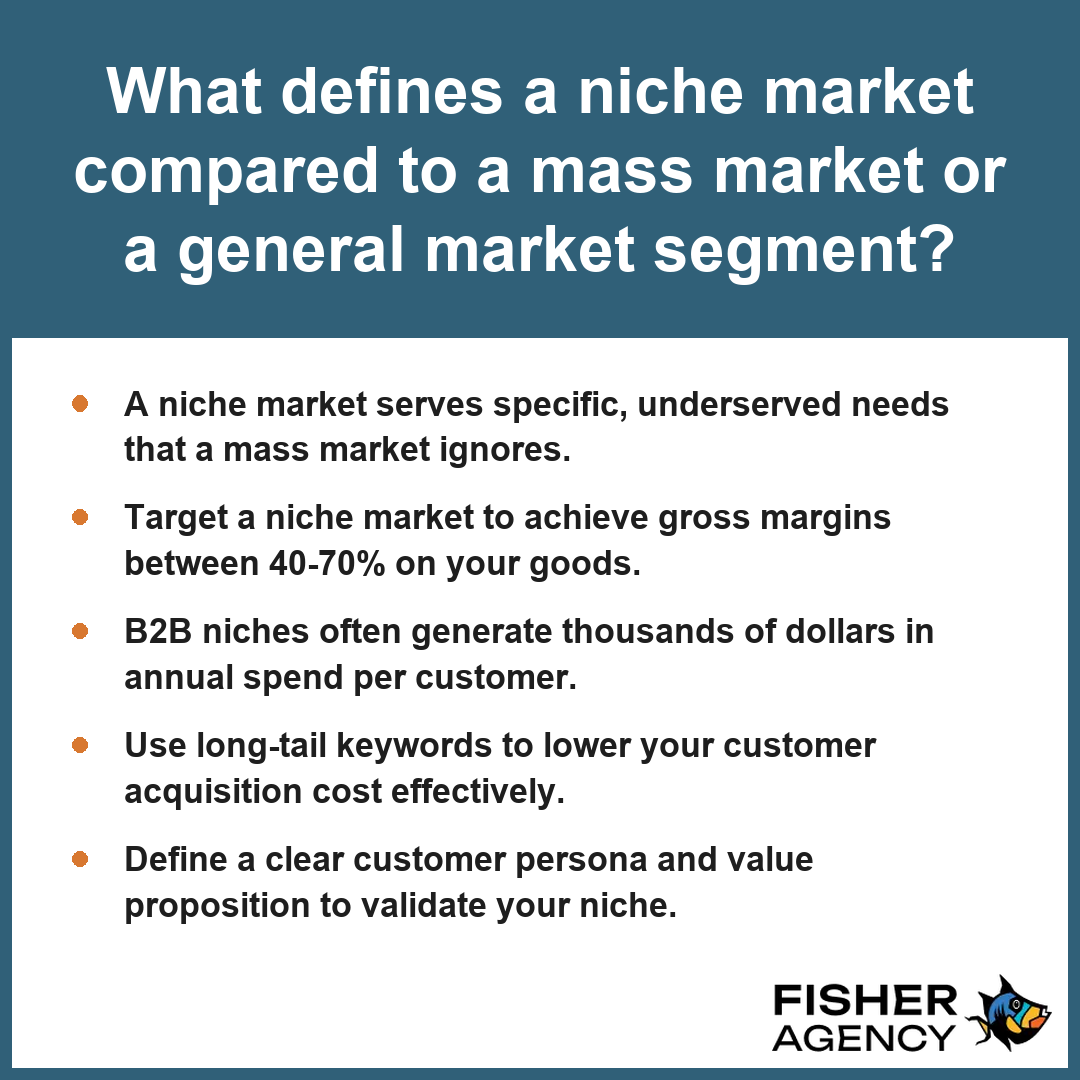
- A niche market serves specific, underserved needs that a mass market ignores.
- Target a niche market to achieve gross margins between 40-70% on your goods.
- B2B niches often generate thousands of dollars in annual spend per customer.
- Use long-tail keywords to lower your customer acquisition cost effectively.
- Define a clear customer persona and value proposition to validate your niche.
What Defines a Niche Market Compared to a Mass Market or a Broader Market Segment?
A niche market is defined by a highly specific customer persona with specialized needs that allow you to command a 40-70% gross margin through a tailored value proposition, whereas a mass market targets a vast range of total addressable customers with generalized offerings that prioritize volume over specialized depth.
Target Gross Margin Comparison
Who the Customers Are and What They Need
A niche market is defined as a specific subset of a broader industry that possesses unique needs or preferences that are largely overlooked or underserved by mass market suppliers. While a mass market targets vast, heterogeneous groups with standardized, one-size-fits-all products, a niche market focuses on smaller groups defined by specialized characteristics. According to the American Marketing Association, niche markets often achieve profitability by leveraging superior product alignment to command premium pricing and foster higher levels of customer loyalty, unlike mass markets that rely primarily on broad appeal and economies of scale.
How a Customer Persona Sharpens the Definition
You define these groups by analyzing specific traits that drive demand for specialized solutions. The following table contrasts the identifying characteristics of these two approaches:
| Feature | Mass Market | Niche Market |
|---|---|---|
| Primary Focus | Broad, average demand | Specialized, deep demand |
| Product Strategy | Standardized, universal | Tailored, feature-specific |
| Competitive Density | High, price-driven | Low, value-driven |
Why Positioning and Value Proposition Set a Niche Market Apart
Your success within a niche market relies on a precise value proposition that addresses the specific pain points of your audience. Unlike mass market sellers who compete on volume and price, you differentiate through expertise and functional fit. Your positioning must communicate that you are the primary, or perhaps only, provider capable of solving a particular challenge, such as supplying high-performance components for a specific profession or luxury items for an ultra-budget constrained user. This intentional alignment turns your product into a necessity rather than a commodity.
Is a Narrow Market Segment Always a Niche Market?
No, a narrow market segment is not always a niche market because a segment represents any subdivision of a larger group, whereas a niche market specifically implies a lack of competition and a high degree of specialization. Many market segments are simply smaller slices of a broad audience that remain subject to standard, mass-produced offerings. To qualify as a true niche, the group must demonstrate a distinct set of values, behaviors, or use cases that make them unreceptive to standard products.
Evaluate your target segment’s unique problems to ensure they require a specialized solution that existing mass market players are unable or unwilling to provide.
Effective niche positioning requires strategic execution beyond simple product differentiation:- Minimize acquisition costs: Leverage hyper-targeted communities and influencer partnerships to reach buyers without broad-spectrum advertising spend.
- Iterate through direct feedback: Utilize intimate customer relationships to refine specific features faster than larger competitors can pivot.
- Build high barriers to entry: Cultivate deep brand authority and domain expertise that mass-market generalists cannot easily replicate.
- Optimize supply chain focus: Concentrate procurement on specialized components that meet high-end requirements rather than mass-market commodity materials.
How Big Should a Niche Market Be to Be Profitable?
A niche market is large enough to be profitable when the total addressable customers provide sufficient revenue to cover operational costs while sustaining a gross margin of 40-70% for specialized goods. The size of the group matters less than the density of demand and the ability of those individuals to support your pricing model. In a business-to-business niche market, the average annual spend per customer is often in the thousands of dollars, meaning a small pool of clients can generate significant volume. For consumer goods, the viability depends on the frequency of sales and the specific spending power of the demographic. Per the Federal Trade Commission, market feasibility generally hinges on ensuring that the cost of acquiring customers stays lower than their expected lifetime value so that marketing expenses do not erode profit margins.
| Market Segment | Primary Revenue Driver | Minimum Viable Density | Target Margin Profile |
|---|---|---|---|
| B2B Specialized Goods | High Annual Contract Value | Low Client Count (High Spend) | 40-70% Gross |
| B2C Niche Commodities | Purchase Frequency | High User Volume (Low Spend) | 40-70% Gross |
Target Gross Margin Range (%)
To determine if your niche market size supports your goals, evaluate the following factors:
- Total addressable customers: Verify that the reachable population size exceeds your break-even point.
- Average annual spend per customer: Ensure the recurring revenue potential aligns with your product development costs.
- Market saturation: Confirm that the existing number of suppliers is low enough to allow for meaningful capture of share.
- Purchase frequency: Assess if the product allows for a healthy repeat purchase rate to sustain long-term growth.
Calculate your specific break-even volume by dividing your total annual overhead by the expected net profit per individual unit sold to ensure the math supports your business model.
Conduct a validation audit by assessing these specific operational metrics:- Calculate the Customer Acquisition Cost (CAC) to ensure it remains below 33% of the projected Lifetime Value (LTV).
- Analyze competitor saturation levels to determine if the niche is underserved or if market entry requires a disruptive pricing strategy.
- Evaluate the price elasticity of demand to confirm the target demographic can absorb a premium price point.
- Confirm the scalability of supply chain logistics to ensure growth does not disproportionately increase your variable cost per unit.
What Profit Margins Can You Expect When Selling to a Niche Market?
Profit margins when selling to a niche market typically fall within a range of 40-70% for specialized goods, significantly outpacing the margins achievable in a mass market. Because you provide a solution tailored to specific requirements that standardized products fail to address, your customers prioritize the exact fit and deep expertise you offer over finding the lowest price point. This diminished price sensitivity allows you to maintain higher pricing power and capture a larger share of the value you create.
| Strategic Advantage | Niche Market Impact | Mass Market Benchmark |
|---|---|---|
| Gross Profit Margin | 40% – 70% | < 20% |
| Price Sensitivity | Low (Value-Driven) | High (Commodity-Driven) |
| Customer Acquisition | Targeted/Efficient | Broad/Expensive |
| Competitive Pressure | Minimal (Specialized) | Intense (Undifferentiated) |
| Customer Retention | High (Exclusive Need) | Variable (High Churn) |
Profit Margin Comparison
- Pricing Authority: By addressing an underserved need, you reduce direct price competition, which supports a higher gross margin.
- Operational Efficiency: Specialization allows you to streamline inventory and production to focus only on features that your identified customer persona truly values.
- Reduced Marketing Waste: Because your reach is focused, you avoid the high customer acquisition cost associated with broad, untargeted advertising campaigns. Per Journal of Marketing, businesses that target these specialized segments frequently see greater profitability than mass-market firms because they benefit from lower costs to acquire customers and stronger loyalty.
- B2B Revenue Potential: Within professional sectors, the average annual spend per customer in a niche market often reaches thousands of dollars, further stabilizing your profitability.
- Higher Retention: Limited alternatives for your specialized offerings lead to a higher repeat purchase rate, which compounds the long-term profitability of every customer acquired.
Analyze your current unit economics to determine if your production costs allow for this premium positioning before you commit to deeper specialization.
To maximize these profit margins, focus on these tactical implementation strategies:- Tiered Service Models: Offer premium “concierge” tiers to capture additional value from your highest-intent niche customers.
- Community-Led Feedback Loops: Use direct engagement with your specialized audience to iterate on product features faster than mass-market competitors.
- Content Authority Building: Develop deep technical documentation or expert-level education that solidifies your brand as the industry standard, further insulating you from price wars.
- Strategic Partnerships: Collaborate with non-competing businesses that serve the same niche to lower customer acquisition costs through shared audiences.
How to Find and Validate a Niche Market Step by Step
To find and validate a niche market, you must follow a structured process that transitions from initial hypothesis to confirmed commercial demand. This methodical approach minimizes risk by ensuring your product serves an underserved need before you invest heavily in production or inventory.
| Validation Phase | Methodology | Key Performance Indicator |
|---|---|---|
| Identify | Gap Analysis | Unmet Specific Requirement Density |
| Research | Search Intent & Community Monitoring | Long-Tail Keyword Volume Intensity |
| Analyze | Competitive Landscape Audit | Feature-to-Pain-Point Alignment Ratio |
| Define | Demographic & Expenditure Profiling | Disposable Income vs. Acquisition Cost |
| Test | Minimum Viable Offering Deployment | Validated Conversion Rate |
| Refine | Iterative Value Proposition Tuning | Customer Sentiment & Feedback Velocity |
- Identify an underserved need: Search for groups whose unique requirements, such as specific professional demands or specialized lifestyle values, are ignored by mass market providers.
- Research demand: Use search volume data for long-tail keywords, monitor niche-specific community forums, and analyze trade publication discussions to gauge the intensity of the problem.
- Analyze competitors: Evaluate whether existing solutions are generic or if they truly address the specific pain points of your target audience.
- Define a customer persona: Construct a detailed customer persona that outlines the specific demographics, behaviors, and financial capacity of your potential users. Per Bureau of Labor Statistics, data from the Consumer Expenditure Survey can be used as an approximation to validate if your target niche has the necessary purchasing power to support a sustainable business model.
- Test the offering: Launch a limited, low-cost version of your product or service to a small group to measure actual conversion rates and collect authentic feedback.
- Refine positioning: Adjust your value proposition based on direct user interactions, ensuring your messaging clearly emphasizes your expertise and specialized fit.
Before committing further capital, confirm your total addressable customers to ensure the projected volume supports your target gross margin of 40-70%.
To translate these insights into actionable execution, implement the following tactical steps:- Synthesize search trends: Use social listening tools to track the specific vernacular and recurring complaints used by your target audience.
- Pilot acquisition: Run low-budget targeted advertisements to a landing page to measure click-through rates before building the actual product.
- Secure pre-orders: Establish proof of intent by requiring a financial commitment or email sign-up for early access to your offering.
- Optimize feedback loops: Interview the first ten interested prospects to identify friction points in your proposed value proposition.
Marketing to a Niche Market on a Small Budget
Marketing to a niche market on a small budget relies on precision rather than reach, allowing you to lower your customer acquisition cost by avoiding the waste inherent in broad campaigns. Per the Small Business Administration, developing a niche strategy allows small businesses to compete effectively by focusing resources on specific customer segments that are often underserved by larger competitors. Because your audience is highly specific, you can replace expensive, generalized advertising with highly targeted outreach that speaks directly to the unique needs of your customer persona. By leveraging channels where your potential buyers already congregate, you maximize the impact of every dollar spent.
| Strategic Lever | Optimization Target | Budget Impact | Primary Benefit |
|---|---|---|---|
| Long-tail SEO | High-intent niche queries | Minimal (Organic) | Captures low-competition traffic |
| Specialized Communities | Forum/Newsletter members | Zero (Time-based) | Builds domain authority |
| Micro-Influencers | High-trust, small groups | Low (Barter or flat fee) | Generates qualified referrals |
| Direct-Response Ads | Granular buyer personas | Controlled (Pay-per-click) | Eliminates broad-reach waste |
| Technical Content | Problem-aware prospects | Low (Creation cost) | Establishes credibility/trust |
- Long-tail keywords: Use phrases of three or more words in your content strategy to capture high-intent search traffic with lower competition than broad search terms.
- Specialized communities: Engage directly in forums, trade publications, and professional newsletters where your target audience seeks solutions, establishing your authority without paid ad spend.
- Micro-influencer partnerships: Collaborate with individuals who hold significant sway within a small, focused group to generate high-trust referrals.
- Direct-response social ads: Utilize granular demographic and interest-based targeting tools to ensure your messaging reaches only those who match your specific product fit.
- Content-led expertise: Produce deep-dive technical articles or guides that solve specific problems, serving as a credibility signal that attracts organic interest.
Monitor your conversion rates across different channels to identify which specific platform delivers the highest repeat purchase rate for your product.
To maximize the efficacy of your niche marketing efforts, implement these tactical steps:- Segment your email list: Tailor your messaging based on specific pain points to increase engagement rates among high-intent subscribers.
- Conduct competitor gap analysis: Identify the specific customer questions that industry leaders are ignoring to create high-value, problem-solving resources.
- Host private virtual roundtables: Engage directly with niche experts to build brand advocacy and gather qualitative feedback on your offerings.
- Refine customer personas: Use actual interview data rather than assumptions to ensure your outreach speaks to the specific vocabulary of your target audience.
Frequently Asked Questions
How much does the average customer spend per year in a niche market?
The average annual spend per customer in B2B niches reaches thousands of dollars, while consumer niches typically range from tens to several hundred dollars. These figures fluctuate based on the specific industry, but higher spending levels remain common because these customers prioritize specialized value over the lowest possible price.
Do niche markets have less competition, and what happens when bigger companies enter?
Yes, niche markets often have less competition than a mass market because they serve specialized subsets with distinct needs. When larger firms enter, your business maintains its advantage by leveraging higher gross margins, typically 40-70%, and superior expertise that larger, standardized competitors often struggle to match or replicate authentically.
How do you position a product in a niche market so buyers see it as the only choice designed for them?
You position a product by developing a clear value proposition identifying it as the only solution for a specific need, supported by credibility signals like expertise and reviews. By focusing on a well-defined customer persona, you demonstrate that your offering is purpose-built rather than a broad, standardized mass market solution.
Are customers in a niche market more loyal than customers in a broad market?
Yes, customers in a niche market demonstrate higher loyalty because alternative options are limited. This leads to a stronger repeat purchase rate and increased word-of-mouth referrals compared to a mass market, as your specialized focus on distinct preferences creates a deeper connection than standardized products can ever achieve.
How do you grow a business beyond a niche market without losing what makes it work?
You grow by maintaining your core value proposition while expanding into adjacent segments or creating new specialized offerings. This allows you to scale while keeping the expert positioning that characterizes a successful niche market, ensuring that you do not sacrifice the high-margin, loyal customer base that initially fueled your business.