

Search Engine Optimization: Timeline, Cost, Ranking Factors, Types, Metrics, Backlinks, Tools, Page Speed, Risks
Everything you need to know about “search engine optimization”: cost, timeline, types, ranking factors, backlinks, metrics, page speed, tools, and risks. Search engines rank pages by evaluating signals such as relevance, content quality, site speed, and the links that point to a page. In marketing, this work supports steady, unpaid traffic that complements advertising, email, and social channels. Some businesses assign the work to an internet marketing agency, while others handle it with in-house staff, and you will find that each approach affects budget and speed of results. The article explains typical costs, the timeline for results, the main types such as technical, on-page, and off-page work, the major ranking factors, and the role of backlinks.
Key Takeaways
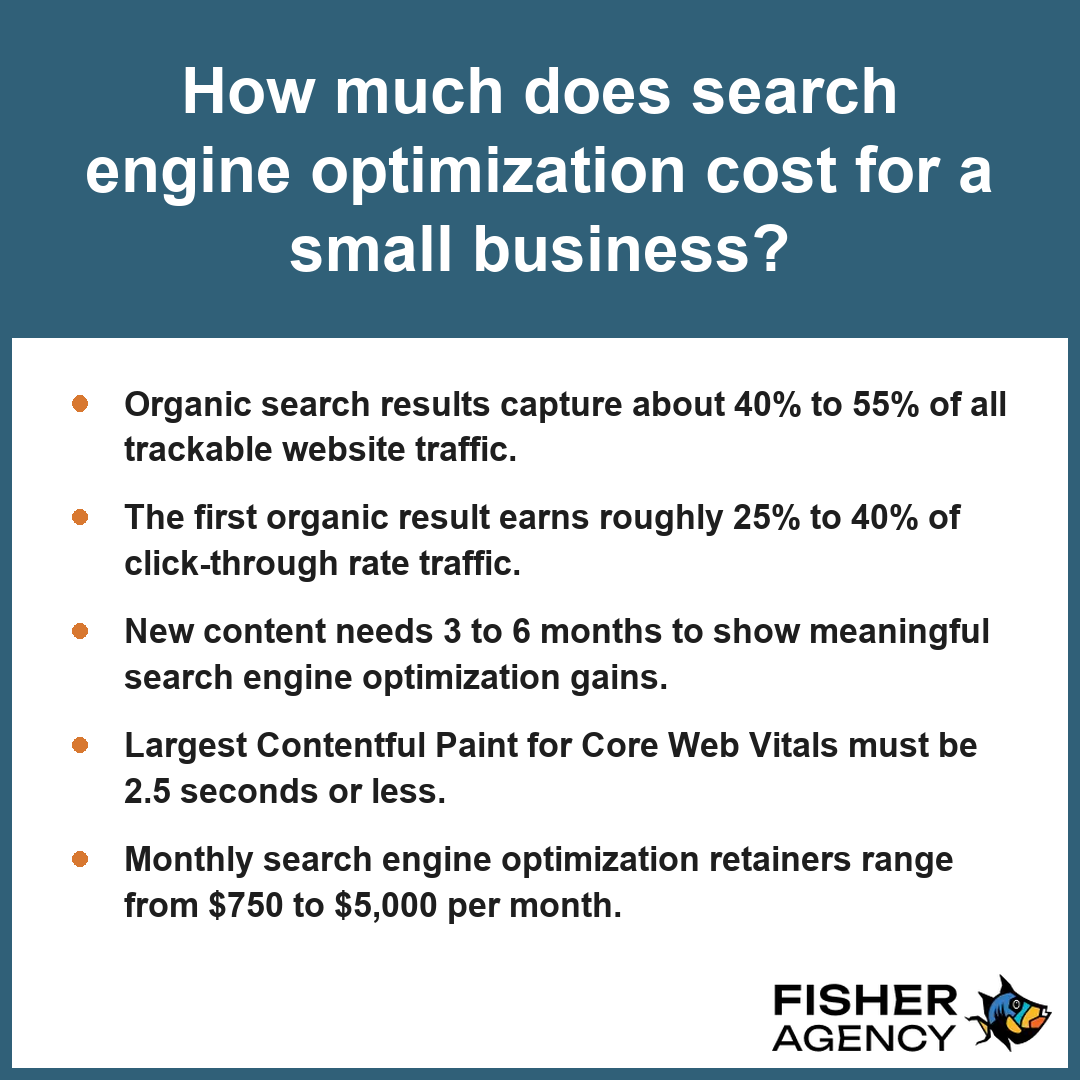
- Organic search results capture about 40% to 55% of all trackable website traffic.
- The first organic result earns roughly 25% to 40% of click-through rate traffic.
- New content needs 3 to 6 months to show meaningful search engine optimization gains.
- Largest Contentful Paint for Core Web Vitals must be 2.5 seconds or less.
- Monthly search engine optimization retainers range from $750 to $5,000 per month.
What Does Search Engine Optimization Cost for a Small Business?
The costs of search engine optimization for a small business range from a few hundred dollars for one-time diagnostic work to several thousand dollars per month for comprehensive, ongoing management. These figures reflect the varying levels of labor, technical expertise, and strategic planning required to compete for visibility within organic search results.
SEO Investment: Median Monthly Expenditure Range
| Service Model | Typical Cost Range |
|---|---|
| Freelancer Hourly Rate | $50 to $150 per hour |
| Monthly Retainer | $750 to $5,000 per month |
| One-time Audit | $500 to $5,000 |
When you evaluate these pricing structures, consider whether your goals necessitate a project-based audit to identify foundational issues or a recurring retainer to maintain performance against competitors over the long term. Per the Small Business Administration, small businesses typically allocate between 7% and 8% of their total annual revenue to marketing and advertising, a portion of which is commonly directed toward search engine optimization. A higher monthly expenditure typically provides deeper involvement in content strategy, link building, and consistent technical monitoring, whereas hourly or project-based engagements are generally restricted to targeted, specific tasks. Before committing to a budget, request a scope of work that details the exact deliverables to ensure your investment directly supports the metrics that influence your specific business objectives.
Audit your current website performance in Google Search Console to determine if your primary needs are immediate technical repairs or a sustained content development campaign.
To maximize the return on your SEO investment, follow these strategic steps when vetting potential service providers:- Define your primary business objectives, such as lead generation, e-commerce sales, or brand awareness, to align with the agency’s proposed KPIs.
- Request a detailed audit of your site’s current technical health and backlink profile to establish a performance baseline.
- Ask for transparent reporting metrics that track organic traffic, keyword rankings, and conversion rates rather than vanity metrics.
- Verify the provider’s experience within your specific industry to ensure they understand your target audience’s search intent.
- Establish clear communication channels and frequency for performance reviews to adjust strategy based on evolving search engine algorithms.
How Long Search Engine Optimization Takes to Show Results
Search engine optimization takes 3 to 6 months to show meaningful ranking gains for new content, though highly competitive terms can require 12 months or longer to reach significant visibility. According to Google Search Central, SEO is an iterative process where businesses should generally expect to wait between four and twelve months to start seeing potential benefits from their website improvements. Because search engines must discover, crawl, and index your content before assessing its quality against established competitors, patience is a required component of your strategy. The timeframe depends heavily on your current site authority, the level of competition for your target keywords, and the consistency of your content production.
| Project Phase | Primary Objective | Expected Milestone Window |
|---|---|---|
| Foundation & Audit | Resolving technical debt and intent-based keyword mapping | Months 1-2 |
| Content Maturation | Initial crawling, indexing, and low-competition rank emergence | Months 3-6 |
| Authority Scaling | Stabilizing search positions and optimizing click-through rates | Months 6-12 |
| Competitive Expansion | Targeting high-volume keywords and long-term search dominance | Months 12+ |
Typical SEO Milestone Timelines (Months)
You can manage your expectations by understanding how the timeline typically segments across a standard campaign:
- Months 1-2: Technical site auditing, keyword research, and addressing foundational issues.
- Months 3-6: Initial indexing of new content and early shifts in rankings for lower-competition keywords.
- Months 6-12: Gradual improvements in click-through rate as rankings stabilize and domain authority grows.
- 12+ Months: Evaluation of long-term growth and expansion into high-volume, highly competitive search terms.
Monitor your performance data using Google Search Console to identify which specific pages are gaining traction and which require further optimization to improve their position.
To optimize your long-term search performance, follow these supplementary strategic steps:- Monitor Google Search Console for crawl errors to ensure your content remains accessible to search bots.
- Refresh existing high-performing pages with updated data or expanded sections to maintain relevance.
- Analyze user engagement metrics like bounce rate and dwell time to identify content that needs improved alignment with search intent.
- Build internal linking structures to pass authority from your strongest pages to new, developing content.
What Are the Main Types of Search Engine Optimization in Marketing?
The main types of search engine optimization include on-page SEO, technical SEO, off-page SEO, and local SEO, all of which you must leverage to improve your visibility in organic search results.
| SEO Optimization Pillar | Primary Technical Objective | Metric/Standard Benchmark |
|---|---|---|
| Technical SEO | Site Crawlability & Indexing | Largest Contentful Paint (≤ 2.5s) |
| On-Page SEO | Title Tag Optimization | 50–60 Characters |
| On-Page SEO | Meta Description Accuracy | 150–160 Characters |
| Technical SEO | Crawler Protocol Compliance | Robots Exclusion Protocol |
Recommended Character Limits for SEO Meta Tags
On-Page SEO and Technical SEO
The main types of search engine optimization in marketing consist of four distinct pillars: technical, on-page, off-page, and local. These work together to ensure your site is both discoverable by search bots and valuable to human users.
How Does Technical SEO Support Crawling and Indexing?
Technical SEO focuses on the structural health of your website to ensure search engines can efficiently navigate your pages. This involves optimizing site speed, implementing structured data, and meeting Core Web Vitals, such as ensuring a Largest Contentful Paint of 2.5 seconds or less. According to the Internet Engineering Task Force, technical on-page optimization relies on adherence to standardized protocols like the robots exclusion protocol to ensure web crawlers can effectively index and interpret content. When your foundation is sound, crawlers index your pages more accurately, providing the necessary stability for your content to rank.
On-page SEO complements this by focusing on the content itself. This pillar includes:
- Optimizing title tags to stay within the 50-60 character range.
- Crafting meta descriptions within 150-160 characters.
- Aligning headings and body copy with specific user intents, such as informational or transactional goals.
Off-Page SEO and Local SEO
Off-page SEO centers on building your site’s authority through brand mentions and the acquisition of backlinks. These signals tell engines that other sources trust your content. Local SEO, meanwhile, optimizes your visibility for geographic-specific queries. This requires managing your business profile, maintaining accurate local citations, and actively soliciting authentic customer reviews.
Which Type Should You Prioritize First?
You should prioritize these activities in a logical sequence to build a sustainable foundation for organic search results:
- Technical SEO to ensure your site is crawlable and performs well under Core Web Vitals.
- On-page SEO to organize your content around relevant keywords.
- Off-page and local SEO to build the authority required to capture the click-through rate dominance of the top results.
Audit your site speed and crawl errors in Google Search Console before committing resources to content expansion.
To enhance your website’s performance beyond the foundational metrics, consider these strategic off-page and local SEO practices:- Acquire high-quality backlinks from authoritative domains to improve your site’s domain authority and search rankings.
- Manage your Google Business Profile to ensure NAP (Name, Address, Phone) consistency across all local directories.
- Engage in social media sharing to drive referral traffic and increase brand signals for search engines.
- Encourage and respond to customer reviews to build trust and improve local pack visibility.
- Monitor brand mentions across the web to identify new opportunities for link building and reputation management.
Ranking Factors That Search Engine Optimization Focuses On
Ranking factors that search engine optimization focuses on are the specific criteria and signals that automated systems use to score and sort indexed pages in response to a user query. Because organic search results capture about 40% to 55% of trackable website traffic, search engine optimization prioritizes elements that demonstrate relevance, authority, and high-quality page experience to capture the top positions that earn 25% to 40% of all clicks.
| Optimization Pillar | Key Performance Benchmark | Primary Objective |
|---|---|---|
| Content Intent | Search Query Alignment | Satisfy User Information Needs |
| Core Web Vitals | LCP ≤ 2.5s; INP ≤ 200ms; CLS ≤ 0.1 | Optimize Page Loading Experience |
| On-Page Metadata | Title: 50–60 chars; Meta: 150–160 chars | Maximize Click-Through Rate |
| Authority Metrics | Backlink Profile & Brand Mentions | Establish Domain Trustworthiness |
| Content Quality | Depth and Originality | Outperform Competing Indexed Pages |
Search Engine Traffic and Click Metrics
- Content Relevance and Intent: Aligning text and media with user search intent—whether informational, navigational, commercial, or transactional—to ensure the page directly answers the query.
- Core Web Vitals: Meeting technical performance thresholds, specifically a Largest Contentful Paint of 2.5 seconds or less, an Interaction to Next Paint of 200 milliseconds or less, and a Cumulative Layout Shift of 0.1 or less.
- On-Page Optimization: Structuring title tags within 50 to 60 characters and meta descriptions within 150 to 160 characters to improve visibility and click-through rate.
- Content Quality: Providing original, comprehensive, and valuable information that satisfies the user’s requirements better than competing pages.
- Authority Signals: Leveraging high-quality backlinks and brand mentions to establish trustworthiness within the search engine’s indexing systems.
Monitor your performance metrics within Google Search Console to identify which of these ranking signals currently underperform for your specific pages.
To maintain competitive search visibility, implement the following technical and strategic workflow:- Conduct keyword research to map search volume against specific user intent categories.
- Audit internal site architecture to ensure search crawlers can efficiently index deep-linked pages.
- Implement structured data markup to enhance search result appearance via rich snippets.
- Update legacy content periodically to maintain topical relevance and address evolving search trends.
- Monitor server-side performance logs to identify and resolve crawl errors or 4xx status codes.
Do Backlinks Still Matter, and Which Kinds Are Safe to Build?
Yes, backlinks still matter significantly for search engine optimization because they serve as a primary signal to ranking systems that your content is authoritative and trustworthy. While search engine algorithms have become more sophisticated at identifying low-value tactics, high-quality links remain a top factor for improving your position in organic search results. The key is to prioritize the relevance and authority of the linking site rather than the raw number of connections; per Google Search Central, manipulative link building practices designed to influence search rankings, such as purchasing links or engaging in link schemes, violate quality guidelines and may result in reduced visibility for your site.
| Link Acquisition Strategy | Primary Value Proposition | Typical Originating Source | SEO Risk Profile |
|---|---|---|---|
| Editorial Placements | Expertise and Trust Signals | Journalists and Industry Bloggers | Low (Organic/Merited) |
| Resource Page Contributions | Contextual Relevance | Industry Directories and Guides | Low (User-Centric) |
| Partnership Links | Institutional Authority | Vendors and Professional Associations | Low (Established Relationship) |
| Original Content Citations | Proprietary Credibility | Whitepapers and Case Study Repositories | Low (Data-Driven) |
| Manipulative Link Schemes | Artificial Ranking Inflation | Purchased/Spam Domains | High (Policy Violation) |
- Editorial placements: Links earned naturally when journalists or bloggers cite your original research, data, or unique perspectives.
- Resource page contributions: Links from highly relevant industry directories or guide pages that provide genuine utility to users.
- Partnership and association links: References from vendors, suppliers, or professional organizations that maintain a clear relationship with your business.
- Original content citations: Links generated when other creators use your proprietary diagrams, whitepapers, or case studies to support their own claims.
Audit your current link profile using Google Search Console to identify and disavow any low-quality or suspicious domains that may be negatively impacting your site’s reputation.
To maintain a sustainable and effective backlink profile, focus on these proactive maintenance steps:- Conduct periodic audits to identify and disavow toxic or spammy inbound links that could negatively impact your domain authority.
- Monitor your brand mentions across the web to reclaim unlinked references by reaching out to site owners for proper attribution.
- Leverage internal linking structures to distribute authority from high-performing pages to new or under-optimized content.
- Focus on digital PR campaigns that prioritize high-traffic, niche-specific publications over general-interest platforms.
Frequently Asked Questions
What Core Web Vitals scores does search engine optimization require for page speed?
Search engine optimization requires Core Web Vitals scores of 2.5 seconds or less for Largest Contentful Paint, 200 milliseconds or less for Interaction to Next Paint, and 0.1 or less for Cumulative Layout Shift. Meeting these specific, measurable thresholds helps search engines evaluate your site’s page experience during the ranking process.
Which metrics should I track to measure search engine optimization success?
You should measure search engine optimization success by tracking organic sessions, impressions, average position, click-through rate, conversion rate, and total revenue from organic visits. Monitoring these specific key performance indicators allows you to assess how well your pages are ranking and how effectively they convert search traffic into actual business value.
What free tools can I use to start search engine optimization?
You can start search engine optimization using free tools such as Google Search Console, Google Analytics, and Bing Webmaster Tools. These utilities provide essential data regarding how search engines crawl your site, your organic performance, and user behavior, which are fundamental to building an effective strategy for your digital presence.
What are the risks of black-hat search engine optimization tactics?
Black-hat search engine optimization tactics, such as manipulative link schemes, carry the risk of violating platform spam policies and potentially leading to manual actions or lower rankings. Engaging in these practices undermines long-term credibility, as engines prioritize content quality and authentic, relevant backlinks over deceptive efforts to artificially inflate rankings.
Is search engine optimization better than paid search ads for marketing?
No, search engine optimization is not strictly better than paid search; it serves as a core acquisition channel that complements paid search. While organic results capture about 40% to 55% of trackable traffic, marketers use both strategies together to maximize brand awareness, lead generation, and overall market visibility for their business.