

Marketing Goals: Framework, Types, Benchmarks, Metrics, Business Alignment, Time Horizons, Common Mistakes, Budget, Goals vs Strategies

Marketing goals are specific, measurable objectives that define what a marketing effort is intended to achieve for an organization. Key aspects include types, framework, metrics, benchmarks, time horizons, business alignment, budget, common mistakes, and goals vs strategies. In marketing, these objectives give campaigns, budgets and channels a shared direction, so that every activity can be traced back to a business outcome. You usually see them grouped into types such as awareness, lead generation, sales and retention, each linked to a stage of the customer journey. A framework turns a broad ambition into a defined target by pairing it with metrics, benchmarks and a deadline. Searches such as best digital marketing companies near me often reflect a local, outcome-driven need, and that need still has to be expressed as a clear goal before results can be judged. This article explains the main types, a practical framework, common metrics, benchmark sources and the short-, medium- and long-term horizons you can use to organize them.
Key Takeaways
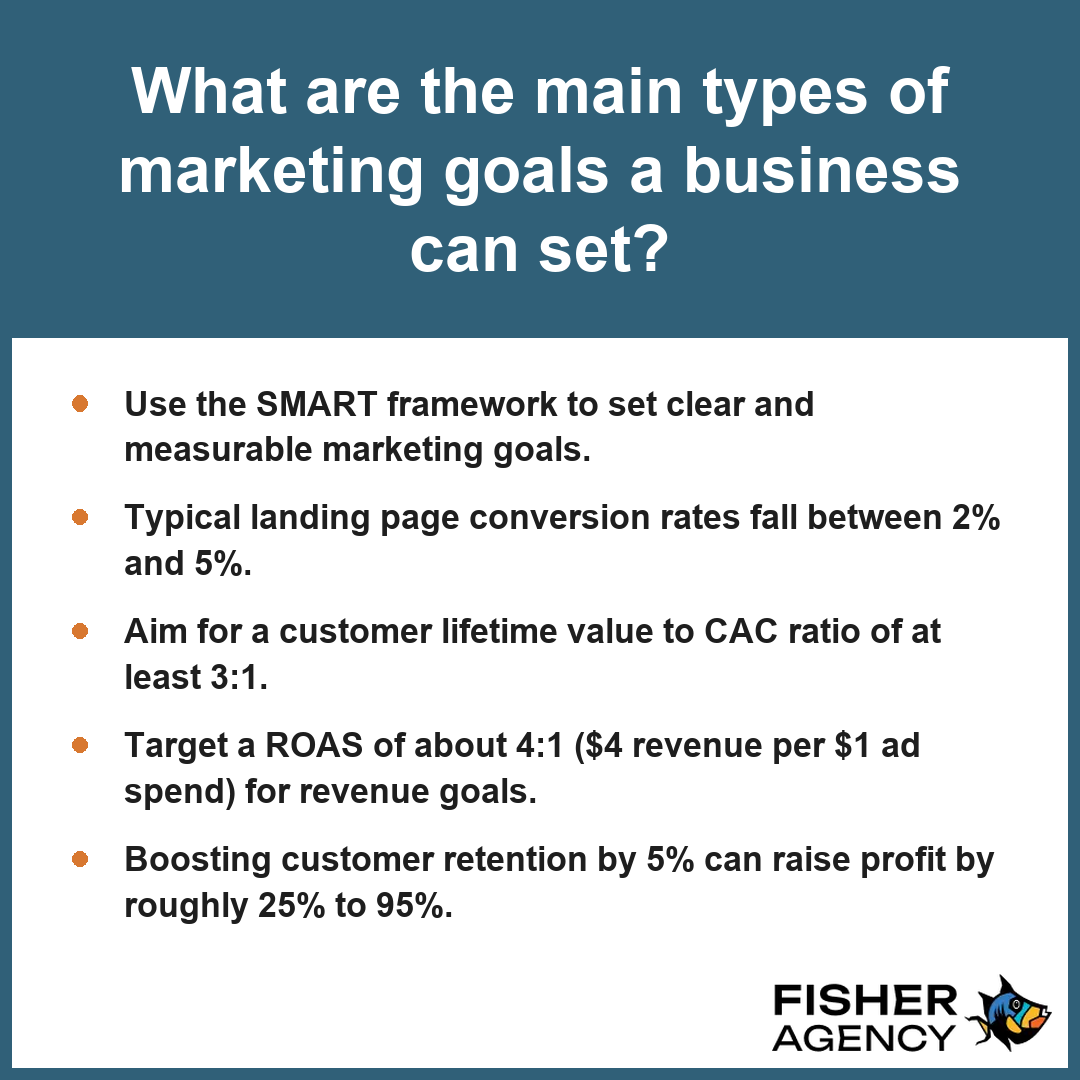
- Use the SMART framework to set clear and measurable marketing goals.
- Typical landing page conversion rates fall between 2% and 5%.
- Aim for a customer lifetime value to CAC ratio of at least 3:1.
- Target a ROAS of about 4:1 ($4 revenue per $1 ad spend) for revenue goals.
- Boosting customer retention by 5% can raise profit by roughly 25% to 95%.
What Are the Main Types of Marketing Goals a Business Can Set?
The main types of marketing goals a business can set are structured categories that translate broader business objectives into actionable outcomes across the customer journey. According to the American Marketing Association, these marketing goals generally fall into foundational categories such as brand awareness, lead generation, customer acquisition, and customer retention. By aligning these specific targets with your growth strategy, you ensure that every tactic contributes to tangible improvements in performance, such as market expansion or long-term profitability. These categories serve as the foundation for your measurement process and resource allocation.
| Marketing Objective | Primary Performance Metric | Industry Target Benchmark | Strategic Impact |
|---|---|---|---|
| Brand Awareness | Branded Search Volume | Market Share Growth | Expanded Presence |
| Lead Generation | MQL Conversion Rate | 2% – 5% | Pipeline Velocity |
| Customer Acquisition | LTV:CAC Ratio | 3:1 | Sustainable Growth |
| Sales and Revenue | Return on Ad Spend | 4:1 | Profitability |
| Customer Retention | Retention Rate Increase | 5% Growth | 25% – 95% Profit Gain |
Typical Marketing Performance Benchmarks
- Brand Awareness: Focuses on increasing your market presence, measured through reach, impressions, and branded search volume.
- Lead Generation: Prioritizes the creation of marketing qualified leads (MQLs) to fill the sales pipeline, targeting conversion rates of 2% to 5% on landing pages.
- Customer Acquisition: Concentrates on gaining new customers while maintaining a customer lifetime value to customer acquisition cost (CAC) ratio of at least 3:1.
- Sales and Revenue: Targets top-line growth through specific return on ad spend (ROAS) benchmarks, typically aiming for 4:1.
- Customer Retention and Loyalty: Centers on deepening existing relationships; notably, raising retention by 5% can increase profit by roughly 25% to 95%.
- Engagement: Monitors interaction depth via email open rates between 20% and 40% and social engagement rates of 1% to 5%.
Audit your current baseline data to determine which of these categories requires the most immediate investment to support your overarching business objectives.
To effectively implement these marketing goals, consider these operational best practices:- Conduct quarterly audits to adjust benchmarks based on shifting seasonal market demand.
- Implement A/B testing protocols on all high-traffic landing pages to optimize conversion paths.
- Integrate CRM data with marketing automation tools to track customer lifetime value more accurately.
- Standardize lead scoring criteria across sales and marketing departments to improve pipeline alignment.
- Utilize predictive analytics to forecast retention trends before churn indicators peak.
How to Write Marketing Goals Using the SMART Framework
You write marketing goals using the SMART framework by ensuring each objective is clearly defined, quantifiable, and aligned with your broader business objectives. This process prevents vague intentions from undermining your strategy by forcing you to define exactly what success looks like and when you expect to achieve it. According to Harvard Business Review, this framework acts as a core management instrument that drives organizational alignment by mandating that all objectives adhere to these five specific criteria.
| Strategic Dimension | SMART Definition Criteria | Resource Allocation Benchmark |
|---|---|---|
| Specific | Identify exact target outcomes | Maintain marketing spend between 5% and 12% of total gross revenue |
| Measurable | Establish quantifiable performance metrics | |
| Achievable | Validate operational capacity | |
| Relevant | Align with core business growth goals | |
| Time-bound | Set fixed completion deadlines |
Marketing Budget as Percentage of Revenue
- Specific: Define the precise outcome you want, such as increasing website leads rather than simply aiming to improve lead generation.
- Measurable: Assign a numeric value to the goal so you have objective baseline data to track your progress; for example, increase website leads from 400 to 500 per month (25% growth).
- Achievable: Verify that your team has the resources and capacity to hit the target, ensuring the goal is ambitious yet realistic.
- Relevant: Confirm that the goal directly supports your primary business objectives, such as scaling revenue or increasing market share.
- Time-bound: Set a clear deadline for completion, such as within 6 months, to create urgency and define the evaluation period.
Before finalizing your targets, calculate the specific resources required to meet the objective to ensure your planned budget remains within the common range of 5% to 12% of total revenue.
To effectively implement these marketing objectives, follow these operational steps:- Audit current marketing technology stacks to ensure data tracking capabilities match your defined KPIs.
- Conduct a historical performance review to ensure numeric growth targets remain realistic based on past conversion rates.
- Schedule recurring monthly reviews to compare actual spending against your established 5%–12% budget benchmark.
- Assign specific ownership of each SMART objective to individual team members to ensure accountability for the defined deadlines.
Which KPIs Should You Use to Measure Each Type of Marketing Goal?
To select the most effective KPIs for your marketing goals, you must align your chosen metrics with specific business objectives and the SMART framework by establishing baseline data to track performance indicators like customer acquisition cost (CAC), return on ad spend (ROAS), and customer retention over a medium-term goal horizon of 6 to 12 months.
| Performance Objective | Key Metrics | Target/Benchmark | Goal Horizon |
|---|---|---|---|
| Market Visibility | Reach, Impressions, Branded Search, Share of Voice | Growth Trend | 6-12 Months |
| Lead Generation | MQLs, Cost Per Lead, Landing Page Conversion | 2% to 5% Conversion | 6-12 Months |
| Customer Acquisition | LTV:CAC Ratio | 3:1 | 6-12 Months |
| Revenue Efficiency | Return on Ad Spend (ROAS) | 4:1 | 6-12 Months |
Benchmark Comparison (Return Ratios)
KPIs for Awareness and Acquisition Goals
KPIs for awareness and acquisition goals serve as essential metrics to gauge how effectively your marketing goals translate into broader market visibility and pipeline growth. Awareness is quantified through reach, impressions, branded search volume, and share of voice. For acquisition, you must track customer acquisition cost (CAC) and conversion performance.
- Awareness: Reach, impressions, branded search volume, and direct traffic.
- Lead Generation: Marketing qualified leads (MQLs), cost per lead, and landing page conversion rates (typical range: 2% to 5%).
- Acquisition Efficiency: Customer lifetime value to CAC ratio (benchmark: at least 3:1).
How Do You Track KPIs for Retention and Revenue Goals?
You track KPIs for retention and revenue goals by monitoring financial health and customer loyalty metrics. Revenue performance relies on marketing-attributed revenue, return on investment (ROI), and return on ad spend (ROAS), with a common target being about 4:1. Per the Marketing Science Institute, return on investment and customer acquisition cost act as fundamental financial KPIs when evaluating the profitability of long-term marketing initiatives. Retention progress requires analyzing churn rates and repeat purchase data.
Linking Customer Retention to Profit
Raising customer retention by 5% can increase profit by roughly 25% to 95%, based on data from a widely cited Bain & Company study. You should measure this success using net promoter scores, which provide a clear signal of long-term loyalty compared to short-term transaction data.
Choosing KPIs That Match Business Objectives
Choosing KPIs that match business objectives requires aligning your specific marketing goals with broader organizational targets like market share or total profit. If your business objective prioritizes rapid growth, emphasize acquisition KPIs; if the focus is long-term stability, prioritize retention metrics. Always compare your current figures against baseline data to ensure your selected indicators accurately reflect real progress toward your intended outcomes.
Audit your current tracking dashboard to ensure your primary KPIs provide a clear line of sight from daily tactical outputs back to your overarching business objectives.
Follow these tactical steps to integrate your selected KPIs into your ongoing marketing reporting workflow:- Standardize data collection by using a unified CRM dashboard to avoid siloed information across platforms.
- Conduct monthly performance reviews to correlate spike events with specific campaign deployments.
- Perform quarterly cohort analysis to identify trends in customer lifetime value that go beyond aggregate averages.
- Adjust bidding strategies based on the variance between realized ROAS and your 4:1 benchmark target.
- Re-calibrate SMART goals every six months to account for shifts in market competition and seasonal fluctuations.
Good Benchmark Numbers for Conversion Rate, Email Open Rate, and ROAS
Good benchmark numbers for conversion rate, email open rate, and ROAS are vital reference points to help you evaluate if your marketing goals align with industry standards. These figures provide a sanity check for your performance data and help you determine whether your current tactics are driving sufficient value.
Average Industry Benchmarks (High-End Targets)
| Metric | Standard Benchmark |
|---|---|
| Landing Page Conversion Rate | 2% to 5% |
| Email Open Rate | 20% to 40% |
| Return on Ad Spend (ROAS) | 4:1 ($4 revenue per $1 ad spend) |
While these benchmarks offer a strong baseline, remember that your specific margins and industry landscape can significantly influence what constitutes success. Per Pew Research Center, email remains a vital communication channel with general industry open rates hovering between 15% and 25% depending on sector specifics and list quality. High performers often push landing page conversion rates above 10%, which can dramatically impact your ability to reach aggressive marketing goals. If your performance falls consistently below these ranges, analyze your baseline data and adjust your funnel strategy to identify potential points of friction. Assess your current conversion paths against these averages to determine if your traffic quality is sufficient to support your growth projections.
To optimize your performance beyond these benchmarks, consider implementing the following strategic adjustments:- Implement A/B testing on call-to-action buttons and hero imagery to incrementally lift conversion rates.
- Segment your email subscriber lists based on behavioral data to increase relevance and improve open rates.
- Audit landing page load speeds to reduce bounce rates and friction in the conversion funnel.
- Analyze ad creative performance to reallocate budget toward high-ROAS channels while cutting underperforming assets.
How Long Does It Take to See Results From Short-Term Versus Long-Term Marketing Goals?
The time required to see results from short-term versus long-term marketing goals varies significantly based on the nature of the engagement and the maturity of your strategy. Short-term marketing goals, typically focused on immediate tactics like paid search ads or email bursts, often produce measurable data within days or weeks. Conversely, long-term marketing goals require a medium-term goal horizon of 6 to 12 months or longer to establish baseline data and demonstrate a consistent return on investment. Per the Journal of Marketing, the elasticity of advertising effects is noticeably greater for short-term sales volume than for long-term brand equity, which instead follows a pattern of delayed cumulative growth and decay.
Average Time Horizon (Months)
The distinction between these timelines is best understood through the following table, which outlines how different objectives progress in terms of visibility and realization:
| Goal Type | Time Horizon | Primary Result Indicator |
|---|---|---|
| Short-Term | Days to 3 months | Traffic spikes and email clicks |
| Medium-Term | 6 to 12 months | Lead volume and conversion consistency |
| Long-Term | 1 to 3 years | Brand equity and customer lifetime value |
When aligning your activities with these timelines, remember that premature evaluation of long-term initiatives can lead to incorrect strategic pivots. Balance your resource allocation by dedicating the majority of your budget to proven, short-term lead generation while reserving a portion for long-term branding efforts that require more time to mature. Audit your current analytics dashboard to confirm that you are not evaluating slow-growth metrics against a short-term timeline.
To ensure your marketing strategy remains resilient and data-driven, implement these best practices for long-term project management:- Establish rolling evaluation windows rather than rigid end-dates to prevent premature campaign termination.
- Segment your performance analytics to separate immediate conversion metrics from incremental brand growth signals.
- Adjust your KPIs quarterly to ensure that long-term initiatives remain aligned with evolving market conditions.
- Maintain a “holdout” control group for long-term strategies to isolate the impact of brand-building from seasonal volatility.
Frequently Asked Questions
How do marketing goals connect to overall business objectives like revenue and market share?
Marketing goals translate business objectives like revenue, profit, and market share into specific marketing outcomes such as customer acquisition or qualified leads. They provide the necessary direction for your strategy, budget, and measurement, ensuring that your team’s efforts directly support the broader financial health and growth of the organization.
What are the steps to set marketing goals for a team?
You set marketing goals by reviewing your business objectives, analyzing baseline data, and choosing a few primary priorities to pursue. Following this, you should apply the SMART framework—ensuring each goal is Specific, Measurable, Achievable, Relevant, and Time-bound—to guide your strategy, allocate your budget, and establish clear KPIs for success.
How much of revenue should a company spend on marketing, and how do goals decide where it goes?
Companies typically spend about 5% to 12% of revenue on marketing budgets. Marketing goals help you justify and allocate this spending across different channels. By defining your intended outcomes, you can distribute your budget to ensure you hit critical benchmarks like a 3:1 customer lifetime value to CAC ratio.
What are the most common mistakes when setting marketing goals?
The most common mistake when setting marketing goals is failing to use the SMART framework, which leads to outcomes that lack a clear time-bound definition or measurable KPIs. Avoid ambiguity by ensuring your targets translate high-level business objectives into specific, actionable metrics rather than vague expectations that cannot be tracked.
What is the difference between marketing goals, strategies, and tactics?
Marketing goals act as your destination, while your strategy is the approach taken to reach them, and tactics are the specific actions performed to execute that plan. For instance, while your goal might be to increase website leads, your strategy guides the direction, and tactics include email campaigns or search ads.