

Product Differentiation: Bases, Types, Selection Criteria, Price Premium, Strategic Role, Positioning Link, Testing Methods, Risks, Success Metrics, Protection
Everything you need to know about “product differentiation”: types, bases, price premium, selection criteria, positioning link, strategic role, risks, testing methods, protection, and success metrics. You can see it at work whenever customers perceive one offering as different from similar ones, which shapes how much they value it and how readily they notice it. Within marketing, it connects product development, pricing, and communication, because the distinctions you create must be visible and relevant to a defined audience. In agency marketing, teams often translate these distinctions into messages and campaigns that express what sets an offering apart. This article goes on to explain the main types and bases of differentiation, how a price premium can result, the criteria used to select a approach, and the link to positioning.
Key Takeaways
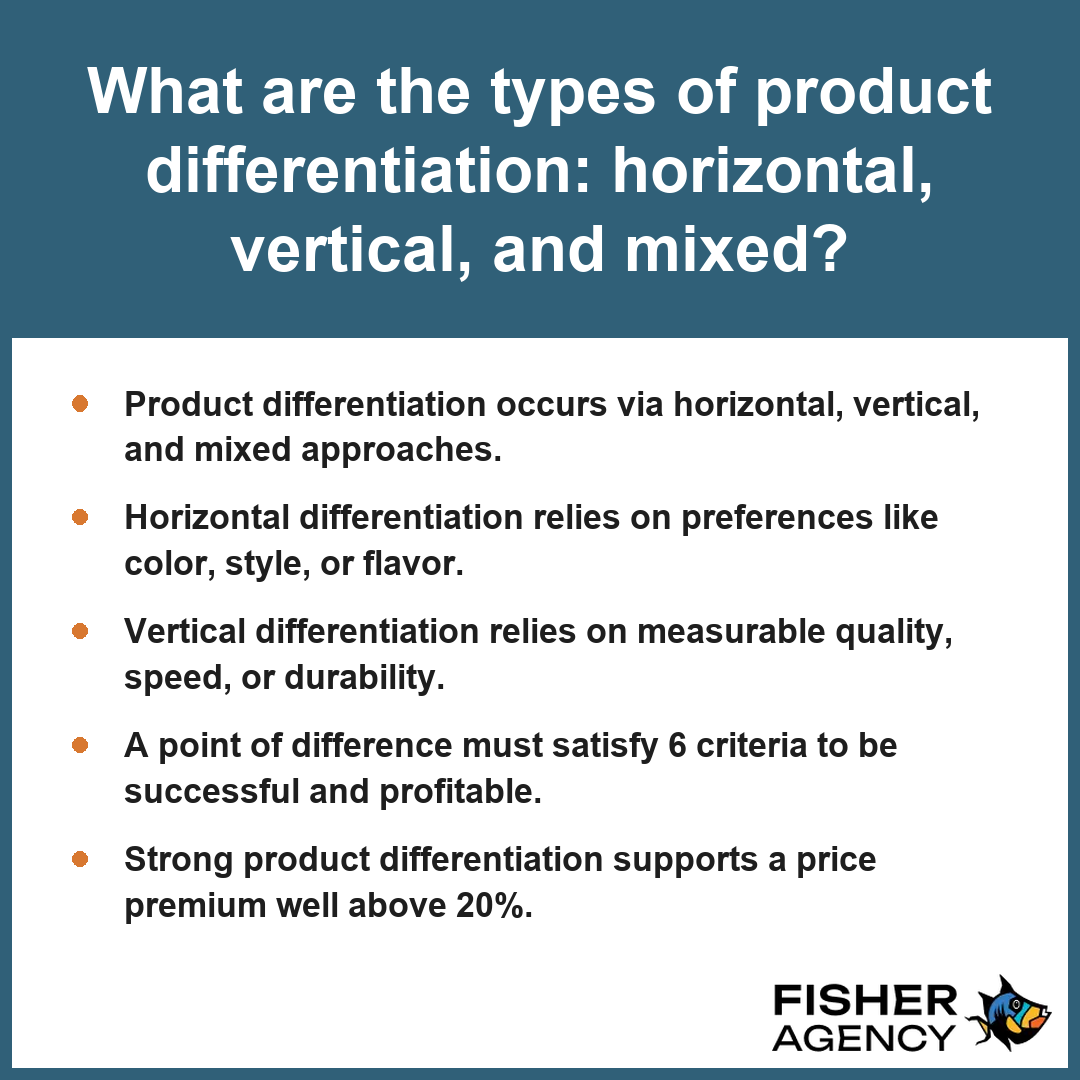
- Product differentiation occurs via horizontal, vertical, and mixed approaches.
- Horizontal differentiation relies on preferences like color, style, or flavor.
- Vertical differentiation relies on measurable quality, speed, or durability.
- A point of difference must satisfy 6 criteria to be successful and profitable.
- Strong product differentiation supports a price premium well above 20%.
What Are the Types of Product Differentiation: Horizontal, Vertical, and Mixed?
Product differentiation occurs through three primary structural categories: horizontal, vertical, and mixed, which categorize how an offering establishes its distinct market standing. Rooted in the monopolistic competition theory introduced in 1933, these categories help you determine whether your strategy relies on subjective preference or objective superiority.
How Does Horizontal Differentiation Work?
Horizontal differentiation involves attributes where no single version is objectively superior to another, but rather where different buyers hold conflicting preferences. It centers on individual tastes where the market disperses across various equally valid choices.
Where Taste and Style Preferences Shape Choice
- Design and visual aesthetics
- Product flavor profiles
- Scent variations
- Stylistic patterns or color options
How Does Vertical Differentiation Work?
Vertical differentiation centers on measurable technical performance or quality tiers, such as speed, battery life, or durability. If all products were priced identically, the vast majority of consumers would choose the high-tier option, as the value gain is clear and quantifiable.
| Factor | Horizontal | Vertical |
|---|---|---|
| Primary Basis | Subjective preference | Objective quality |
| Consumer Consensus | None | High agreement on “better” |
When Mixed Differentiation Applies
Mixed differentiation combines horizontal variety with vertical performance tiers to capture diverse market segments simultaneously. According to the National Bureau of Economic Research, businesses often integrate both vertical quality differences and horizontal variety to successfully reach a wider range of the United States consumer market. You apply this when you offer a high-performance, premium product line that also allows for customization in style, color, or specific accessory configurations. This hybrid approach ensures you satisfy those seeking the highest technical performance while simultaneously appealing to buyers with specific, non-negotiable aesthetic requirements.
Analyze your customer purchase data to identify if your target group prefers trade-offs in quality or variations in style before committing to a development path.
Effective mixed differentiation strategies often incorporate the following elements to balance variety with performance:- Tiered pricing models that reward customers for choosing higher-performance specifications.
- Core functional platforms that remain consistent across all vertical tiers to optimize production costs.
- Modular design architectures allowing consumers to customize aesthetic features without altering technical capabilities.
- Segment-specific marketing campaigns that highlight individual style preferences for lower-tier products and utility for premium models.
The Most Common Bases of Product Differentiation in Marketing
The most common bases of product differentiation in marketing consist of specific tangible and intangible attributes that provide customers with a clear reason to favor one offering over another. Per the American Marketing Association, product differentiation is primarily realized by identifying and highlighting unique features like physical design, quality benchmarks, or brand identity to establish a lasting competitive advantage. By leveraging these dimensions within your product development and the extended marketing mix (7 Ps), you create a point of difference that helps move your offering beyond mere commodity status. These bases range from physical performance metrics to subjective brand perceptions, all of which contribute to your overall strategy.
| Differentiation Pillar | Strategic Objective | Key Performance Indicator (KPI) | Competitive Advantage Type |
|---|---|---|---|
| Performance and Quality | Engineering Superiority | Failure Rate & Efficiency Metrics | Functional Utility |
| Design and Aesthetics | User Engagement | User Experience (UX) Satisfaction Score | Sensory Experience |
| Brand Image and Reputation | Market Positioning | Net Promoter Score (NPS) | Emotional Resonance |
| Service and Support | Customer Retention | Resolution Time & Warranty Claims | Relational Value |
| Delivery and Convenience | Friction Reduction | Conversion Rate & Lead Time | Operational Ease |
| Sustainability and Customization | Niche Penetration | Configuration Adoption Rate | Tailored Relevance |
- Performance and Quality: Superior durability, faster processing speeds, or increased reliability compared to alternatives.
- Design and Aesthetics: Unique visual appeal, ergonomic superiority, or tactile experiences that define the user interaction.
- Brand Image and Reputation: The perceived prestige, ethical stance, or emotional resonance that influences buyer psychology.
- Service and Support: Exceptional customer service, extended warranty periods, or simplified return processes.
- Delivery and Convenience: Reduced lead times, easier access to parts, or more intuitive user interfaces.
- Sustainability and Customization: Verified environmental claims or the ability to tailor features to specific user requirements.
Audit your current feature set against the six criteria for a viable point of difference to confirm that your chosen base is truly distinctive and difficult for rivals to replicate.
To effectively implement these differentiation pillars, consider these supplementary strategic actions:- Conduct a Gap Analysis: Compare your product’s feature set against direct competitors to identify underserved market needs.
- Leverage Unique Value Propositions: Craft messaging that translates technical specifications into tangible benefits for the end user.
- Optimize the Customer Journey: Streamline touchpoints to ensure that perceived value remains consistent from awareness through post-purchase support.
- Execute Pricing Strategy Alignment: Ensure your pricing model reflects the premium nature of your chosen differentiation pillars to reinforce brand positioning.
How Much of a Price Premium Can Product Differentiation Justify?
Product differentiation justifies a price premium by allowing you to command significantly higher margins based on the tangible or perceived value your target market assigns to your offering. Per the Journal of Marketing, the magnitude of a justifiable price premium is positively correlated with the degree of perceived uniqueness, as differentiation shifts consumer focus from cost-based comparisons to value-based attributes. Because you are moving away from the price-sensitive nature of commodities, your pricing power is limited only by the strength of your point of difference and the willingness of customers to pay for it. In common grocery categories, store-brand goods often sell 20% to 30% below national brands, illustrating the baseline disadvantage of lacking effective differentiation. Conversely, when you successfully implement your strategy, strongly differentiated brands can command a price premium well above 20% over the category average, with luxury markets seeing even more dramatic variances.
| Market Positioning Strategy | Relative Price Position | Consumer Sensitivity Driver | Economic Impact |
|---|---|---|---|
| Commoditized/Store-Brand | 20%–30% Discount | Price-based comparisons | Baseline margin suppression |
| Strongly Differentiated | >20% Premium | Value-based attributes | High-margin market leadership |
| Luxury/High-Equity | Variable (High) | Perceived uniqueness | Maximum pricing power |
Price Positioning in Grocery Categories
To determine if your price premium is sustainable, you should monitor your performance against the following metrics that validate the financial impact of your strategy:
- Price premium percentage: The specific markup you maintain above the category average.
- Repeat purchase rate: The frequency with which customers return, confirming they value the difference enough to pay for it again.
- Net Promoter Score: A metric on a range of -100 to +100 that indicates whether your price-to-value ratio is fostering customer advocacy.
- Customer retention rate: The percentage of buyers who remain loyal despite competitive pricing pressure from alternatives.
Calculate your customer acquisition cost against your realized price premium to confirm that your margin growth is not being eroded by excessive marketing or production expenses.
To capitalize on differentiation and maximize pricing power, consider these strategic implementation levers:- Feature Anchoring: Explicitly highlight exclusive patented technologies or proprietary processes that competitors cannot replicate.
- Scarcity Signaling: Limit availability through exclusive distribution or time-bound editions to elevate the perceived status of the offering.
- Service Bundling: Include high-utility, low-marginal-cost services that increase the “total cost of ownership” value rather than just the product unit price.
- Brand Storytelling: Connect your offering to a specific identity or community narrative, shifting the purchase motivation from functional utility to emotional alignment.
- Customer Lifetime Value (CLV) Incentives: Utilize subscription models or loyalty tiers that reward repeat engagement, effectively isolating your customer from short-term price fluctuations of rivals.
How to Choose a Point of Difference That Makes Product Differentiation Work
Choosing a point of difference that makes product differentiation work requires you to rigorously filter potential attributes against six specific criteria to ensure they deliver measurable value. Because your goal is to secure a competitive advantage through one of the 3 generic strategies, you must avoid arbitrary selection and focus on factors that your target customers deem essential rather than merely interesting.
| Strategic Evaluation Criteria | Primary Objective | Analytical Focus |
|---|---|---|
| Importance | Demand Alignment | Correlation with core customer purchase drivers |
| Distinctiveness | Competitive Gap | Market scarcity of the feature or benefit |
| Communicability | Cognitive Friction | Speed and clarity of customer comprehension |
| Defensibility | Sustainable Moat | Barriers to imitation (e.g., patents, IP) |
| Affordability | Willingness-to-Pay | Segment price sensitivity vs. value premium |
| Profitability | Margin Optimization | Net gain after incremental production investment |
- Assess importance: Identify if the target segment prioritizes this attribute when making a purchase decision.
- Verify distinctiveness: Confirm that no other competitor currently offers this feature or benefit in a comparable way.
- Validate communicability: Ensure the benefit is simple enough for customers to notice and understand through your marketing channels.
- Gauge defensibility: Confirm the attribute is hard to copy, such as via proprietary technology or a 20-year utility patent. Per Harvard Business School, effective points of difference must be sustainable over time and difficult for competitors to imitate, often by leveraging unique organizational capabilities or proprietary systems.
- Test affordability: Determine if your target customer is willing and able to pay the price premium required to sustain the feature.
- Calculate profitability: Ensure the increased margins from your chosen point of difference exceed the additional production or marketing costs.
Audit your final candidate against these 6 requirements to confirm it bridges the gap between technical capability and market demand.
Follow these tactical steps to operationalize the evaluation criteria and finalize your selection:- Conduct A/B testing or conjoint analysis to quantify the impact of the chosen attribute on conversion rates.
- Map the attribute against a competitive landscape matrix to visualize the extent of your market positioning gap.
- Perform a cost-benefit sensitivity analysis to confirm that the feature’s value premium exceeds its operational overhead.
- Audit existing marketing collateral to determine if the value proposition can be articulated within a five-second customer attention window.
- Draft a long-term roadmap to bolster defensive barriers, such as securing trade secrets or exclusive partnerships, that prevent rapid replication.
How Product Differentiation Differs From Positioning
Product differentiation differs from positioning by focusing on the actual attributes or perceived qualities of an offering, while positioning defines the specific mental space that offering occupies within the target consumer’s mind. Per the American Marketing Association, product differentiation involves adding unique characteristics to a good or service to make it superior, whereas market positioning is the strategic design of an offering to occupy a distinct and valued place in the customer’s consciousness relative to competitors. While product differentiation involves building tangible or intangible value through features, design, or service to create a point of difference, positioning relies on strategic communication to ensure that specific audience perceives those attributes in a way that aligns with their needs. Essentially, product differentiation provides the substance of the offer, whereas positioning manages the narrative that anchors that offer in a competitive context. You cannot achieve effective positioning without first establishing the underlying product differentiation that justifies the claim.
| Focus Area | Role in Marketing |
|---|---|
| Product Differentiation | Establishes the objective or perceived advantages that create a competitive edge. |
| Positioning | Articulates the intended mental association relative to competing alternatives. |
| STP Integration | Acts as the bridge between technical capability and market recognition. |
Analyze whether your current messaging highlights a point of difference that your customers can actually verify through their direct experience with the product.
To evaluate your current messaging effectively, consider these diagnostic steps:- Audit your value proposition to identify if you are highlighting functional attributes or abstract emotional benefits.
- Map your existing marketing copy against competitor websites to ensure your “mental space” is uniquely claimed rather than generic.
- Verify that your technical specifications act as evidence for your broader brand narrative rather than standing alone.
- Assess whether your customer feedback reflects the specific adjectives you intend to own in their consciousness.
Frequently Asked Questions
How does product differentiation fit into Porter’s generic strategies?
Product differentiation fits into Porter’s generic strategies as one of 3 fundamental approaches used to achieve a competitive advantage. By pursuing this strategy, you intentionally accept higher production costs in exchange for a price premium, positioning your offering as meaningfully superior to competing products in the eyes of your customers.
What are the risks of product differentiation, such as imitation and cannibalization?
The risks of product differentiation include the potential for competitors to imitate your features or for your own offerings to cannibalize existing sales. To succeed, you must ensure your point of difference is hard to copy, meets 6 specific criteria, and remains profitable despite the higher costs required to sustain it.
How do you protect product differentiation from competitors copying it?
You protect product differentiation from competitors by utilizing intellectual property tools, such as a US utility patent which provides 20 years from filing of protection for a unique feature. Additionally, you can strengthen your position through continuous innovation, brand image, and creating customer loyalty that remains difficult for rivals to replicate.
How can you test whether customers actually notice a product’s difference?
You test whether customers notice your difference by focusing on perceived differentiation rather than just technical specifications. Because buyers react to what they notice, you should monitor customer feedback, conduct market research on brand awareness, and track how your positioning strategy translates into actual purchase decisions and preference over competing goods.
Which metrics show whether product differentiation is succeeding?
Metrics that show whether product differentiation is succeeding include your price premium, market share, repeat purchase rate, customer retention rate, and Net Promoter Score, which operates on a range of -100 to +100. Strongly differentiated brands often command a price premium well above 20% compared to the category average.